
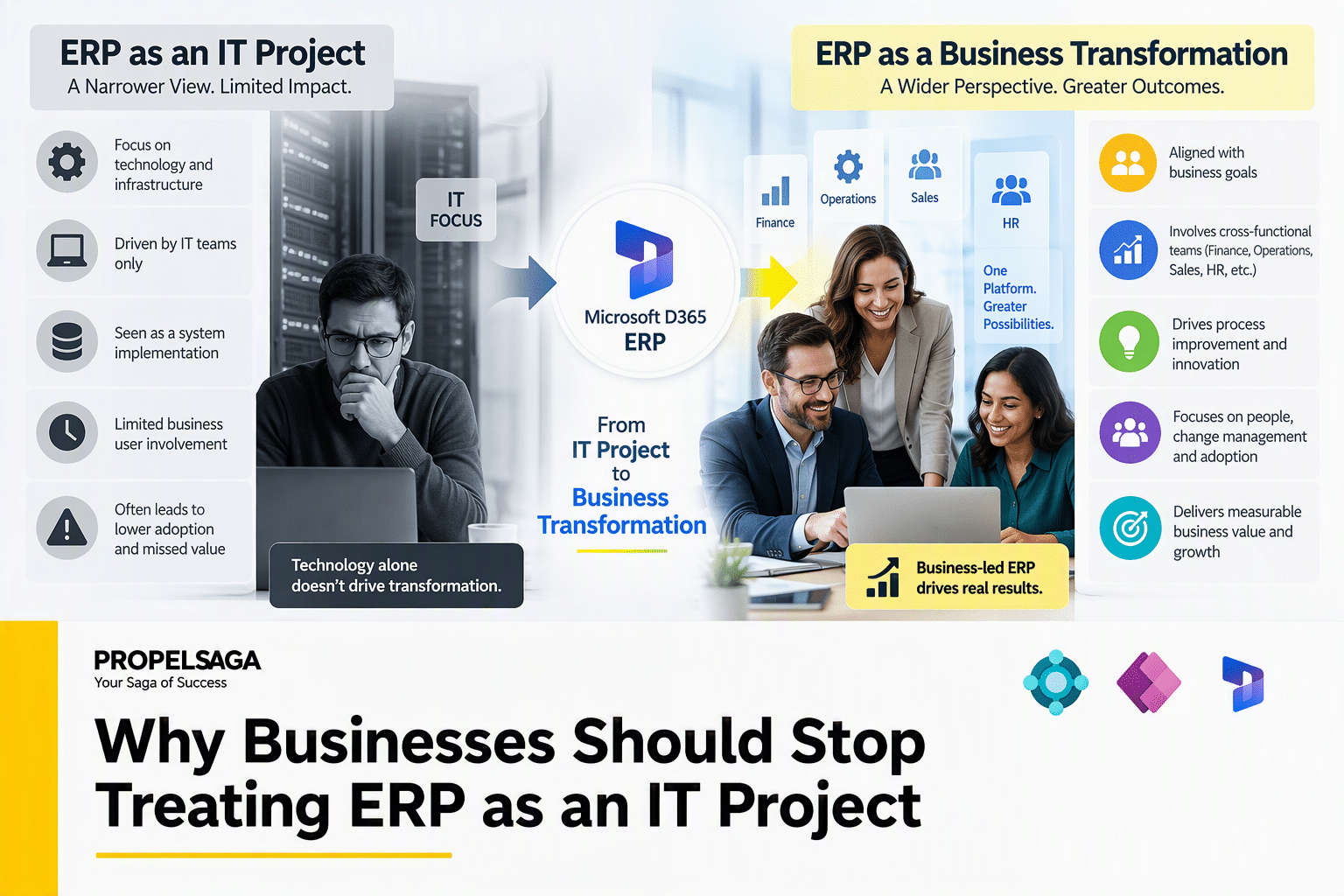
ERP implementation is often placed under the responsibility of the IT department. IT evaluates the technology, manages vendors, oversees integrations, and supports the system after go-live.
But an ERP system is not simply an IT system.
It influences how finance operates, how sales teams manage customers, how procurement works, how inventory is controlled, how employees perform their daily activities, and how leadership gets visibility into the business.
That is why businesses should stop treating ERP as an IT project and start treating it as a business transformation initiative.
ERP Changes How the Business Operates
An ERP implementation often changes existing processes rather than simply replacing old software.
For example:
- Finance may change how reporting and closing activities are performed.
- Procurement may introduce new approval workflows.
- Sales may follow standardized processes.
- Warehouse teams may adopt new inventory procedures.
- Management may gain real-time operational visibility.
- Employees may need to change how they enter and use information.
These are business changes, not just technology changes.
When business teams are not actively involved, even a technically successful implementation can struggle with adoption and deliver limited business value.
IT Alone Cannot Define Business Success
The IT team can ensure that the ERP platform is configured, integrated, secure, and available.
But IT cannot independently define whether the new system is improving the business.
Business leaders need to answer questions such as:
- Which processes should be standardized?
- Where are the biggest operational inefficiencies?
- What information does management need?
- Which activities should be automated?
- What should the future process look like?
- How will success be measured after implementation?
The ERP project should therefore have business ownershipwith IT partnership, rather than IT ownership alone.
Start With Processes, Not Features
One common ERP mistake is starting with the question:
"What features does the system have?"
A better question is:
"What does our business need to achieve?"
For example, instead of implementing a new purchasing module simply because it is available, organizations should first understand their procurement process, approval requirements, supplier management challenges, purchasing controls, and reporting needs.
Technology should support the desired business process—not dictate it unnecessarily.
Leadership Involvement Matters
ERP projects require decisions that extend beyond technology.
Leadership needs to establish:
- Clear business objectives
- Project priorities
- Process ownership
- Decision-making authority
- Change management expectations
- Success measurements
- Post-go-live improvement plans
Without leadership involvement, ERP projects can become focused on configuration, timelines, and technical deliverables instead of business outcomes.
User Adoption Is Part of the Project
A powerful ERP system creates little value if employees continue working outside the system.
Users need to understand:
Why is the organization changing?
How will the new process work?
What changes in their daily responsibilities?
What benefits will they receive?
Training, communication, process ownership, and feedback should therefore be included from the beginning not treated as activities to complete just before go-live.
ERP Should Create Measurable Business Outcomes
The success of an ERP implementation should not be measured only by whether the system went live on time.
Businesses should also measure outcomes such as:
- Faster financial closing
- Better inventory visibility
- Reduced manual data entry
- Improved order processing
- Faster procurement cycles
- Better reporting and decision-making
- Improved process compliance
- Higher user adoption
- Reduced operational dependency on spreadsheets
These metrics shift the conversation from "Did we implement the ERP?" to "Did the ERP improve the business?"
Microsoft Dynamics 365: From ERP Implementation to Business Transformation
Platforms such as Microsoft Dynamics 365 Business Central and Finance & Supply Chain Management provide organizations with capabilities across finance, operations, supply chain, sales, reporting, automation, and AI.
However, technology alone does not deliver transformation.
The value comes from combining the platform with the organization's processes, people, data, and business objectives.
A successful Microsoft Dynamics 365 initiative therefore requires collaboration between business leadership, functional teams, IT, users, and the implementation partner.
The New Mindset
Instead of thinking:
IT owns the ERP project.
Businesses should think:
The business owns the transformation. IT enables it.
This mindset changes how organizations approach ERP selection, implementation, customization, integration, training, adoption, and continuous improvement.
ERP should not be viewed as another software deployment.
It should be viewed as an opportunity to redesign how the organization operates and creates value.
Conclusion
ERP is too important to be treated as an IT project.
It affects people, processes, data, decisions, customers, and ultimately business performance.
The strongest ERP initiatives bring business and technology teams together from the beginning, define measurable outcomes, involve users early, and continuously improve after go-live.
The real success of an ERP project is not when the system goes live. It is when the business operates better because of it.
At PropelSaga, we help Microsoft Dynamics 365 partners and organizations strengthen their ERP capabilities through implementation support, modernization, integration, dedicated expertise, and ongoing business application services.