
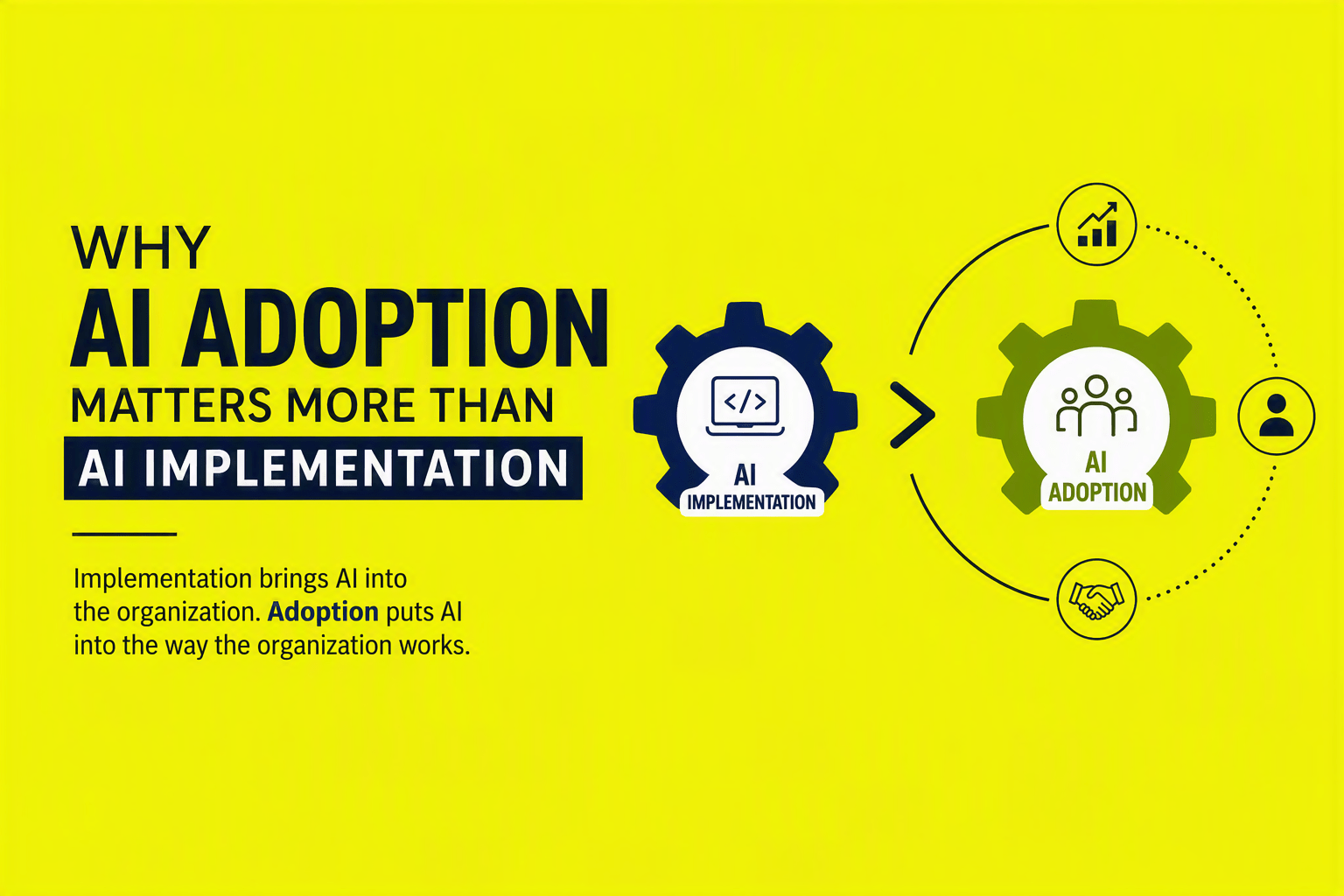
Why AI Adoption Matters More Than AI Implementation
Artificial Intelligence has moved beyond experimentation. Organizations across industries are actively implementing AI to enhance customer service, optimize operations, improve decision-making, support employees, and drive productivity.
Yet one critical question is often overlooked:
Is implementing AI enough?
The answer is no.
An organization can successfully deploy an AI solution, integrate it with existing systems, and make it available to users, but still fail to generate meaningful business outcomes.
This is where AI adoption becomes more important than AI implementation.
Implementation Creates Capability. Adoption Creates Value.
AI implementation is fundamentally a technology initiative.
It involves selecting the right solution, integrating it with business applications, configuring security and governance controls, validating performance, and ensuring the technology is available to users.
AI adoption goes far beyond deployment.
It focuses on questions such as:
- Are employees actively using AI capabilities?
- Do they understand how AI can help them perform their roles more effectively?
- Has AI become part of day-to-day business processes?
- Do teams trust and validate AI-generated outputs?
- Are managers measuring business impact and outcomes?
- Is the organization continuously improving how AI is utilized?
Simply put:
Implementation brings AI into the organization. Adoption embeds AI into the way the organization works.
The AI Implementation Trap
Many organizations make significant investments in AI technology and assume that once the solution is live, the transformation is complete.
However, deploying technology does not automatically change behaviour.
Consider an organization implementing AI capabilities within Microsoft Dynamics 365.
The solution may be capable of:
- Summarizing customer interactions
- Assisting sales teams with recommendations and insights
- Generating business intelligence from data
- Automating repetitive administrative tasks
- Supporting customer service agents with contextual responses
- Helping employees create emails, proposals, and content
- Identifying trends and patterns across operational data
From a technical perspective, everything may work exactly as intended.
Yet if employees continue working the same way they always have, the organization will realize only a fraction of the potential value.
The challenge is rarely the technology itself.
The challenge is adoption.
Why Employees Don't Automatically Adopt AI
Successful AI adoption requires people to change established habits and ways of working.
Employees often have legitimate concerns:
"Why should I use this?"
"Can I trust the output?"
"Will this actually make my work easier?"
"How do I use it effectively?"
Others may simply continue using familiar processes because they are comfortable and proven.
This is why AI adoption should be approached as a business transformation initiative, not merely an IT project.
Technology enables change. People deliver it.
What Successful AI Adoption Looks Like
True AI adoption occurs when AI becomes a natural and trusted part of everyday work.
Instead of asking employees to "use AI," leading organizations redesign workflows around meaningful AI-enabled outcomes.
For example:
- A salesperson uses AI to prepare for customer meetings, identify opportunities, and personalize engagement.
- A customer service representative leverages AI-generated summaries to respond faster and more accurately.
- A finance professional uses AI-assisted analysis to identify anomalies, trends, and risks.
- A manager relies on AI-generated insights to make faster, data-driven decisions.
In each scenario, AI is not being used because it exists.
It is being used because it solves a real business problem.
The most successful AI deployments are those where employees see immediate value in their daily work.
AI Adoption Requires More Than Training
Training is essential, but training alone does not guarantee adoption.
Organizations need a structured framework that guides users from awareness to measurable business outcomes.
1. Identify
Begin by identifying areas where AI can create genuine business value.
Not every process requires AI. Focus on opportunities where AI can improve productivity, decision-making, customer experience, operational efficiency, or revenue generation.
2. Implement
Deploy the appropriate technology.
This includes solution configuration, integrations, security, governance, data readiness, compliance requirements, and operational setup.
3. Enable
Equip employees with the knowledge, confidence, and practical skills needed to use AI effectively.
This may include:
- Role-based training
- Real-world business scenarios
- Prompting best practices
- Governance guidelines
- Ongoing support and coaching
4. Adopt
Embed AI into everyday workflows.
The objective is not simply to train employees once.
The objective is to fundamentally improve how work gets done.
5. Optimize
Measure outcomes and continuously improve.
Organizations should evaluate:
- Productivity improvements
- Time savings
- Process acceleration
- Customer experience enhancements
- Employee engagement
- Cost reductions
- Revenue impact
- Return on investment (ROI)
This creates a continuous improvement cycle:
Identify → Implement → Enable → Adopt → Optimize → ROI
AI Implementation vs. AI Adoption
AI Implementation
- Focuses on technology deployment
- Enables AI capabilities
- Measures technical completion
- Typically project-based
- Makes AI available
- Technology-centric
AI Adoption
- Focuses on people and business outcomes
- Embeds AI into business processes
- Measures business impact
- Continuous and evolving
- Makes AI valuable
- Business-centric
The key distinction is simple:
Implementation asks: "Is the technology deployed?"
Adoption asks: "Is the technology delivering measurable value?"
The Real Measure of AI Success
The success of an AI initiative should not be determined by deployment status alone.
The more important questions are:
- How many employees are actively using AI?
- How frequently is it being used?
- Which business processes have improved?
- How much time has been saved?
- Has decision-making become faster and more accurate?
- Has customer experience improved?
- What measurable ROI has been achieved?
These are the metrics that matter because they shift the conversation from implementation to impact.
Business value, not deployment status, is the true measure of AI success.
AI Adoption Is a Journey, Not a Project
One of the most common mistakes organizations make is treating AI adoption as a one-time initiative.
AI technology continues to evolve rapidly. New capabilities emerge, business priorities change, and employee expectations develop over time.
Organizations should continuously ask:
What can AI help us achieve today that wasn't possible yesterday?
And more importantly:
Where can AI create the greatest business value today?
This mindset transforms AI from a technology investment into a long-term organizational capability.
Unlocking AI Value with Microsoft Dynamics 365
For organizations using Microsoft Dynamics 365, the opportunity is particularly significant.
AI capabilities can be integrated directly into core business functions, including:
- Sales
- Customer Service
- Finance
- Operations
- Supply Chain
- Marketing
- Business Intelligence
Because AI can leverage existing business data, customer interactions, financial information, and operational processes, it has the potential to deliver meaningful value at scale.
However, technology alone is not enough.
Organizations must:
- Identify high-impact use cases
- Prepare employees for change
- Establish practical AI-enabled workflows
- Monitor usage and adoption
- Continuously optimize outcomes
AI within Dynamics 365 is not the finish line. It is the starting point of transformation.
The Bottom Line
AI implementation answers a relatively simple question:
"Did we deploy the technology?"
AI adoption answers the question that truly matters:
"Are we generating measurable business value from the technology?"
The organizations that succeed with AI will not necessarily be those that implement the largest number of AI tools.
They will be the organizations that successfully integrate AI into how their people work, make decisions, serve customers, and drive business performance.
Implementation delivers AI capability.
Adoption converts capability into business impact.
And ultimately, the goal of AI is not to have more AI.
The goal is to build a business that is more productive, more intelligent, more agile, and more valuable.
About PropelSaga
PropelSaga helps organizations move beyond AI implementation toward sustainable AI-driven business transformation.
Our approach focuses on identifying high-value AI opportunities, enabling user adoption, optimizing business processes, and ensuring organizations realize measurable outcomes from their AI investments.
We help businesses bridge the gap between AI capability and business impact, turning technology investments into real-world results.
Because successful AI transformation is not about deploying AI. It's about creating measurable business value through AI.