
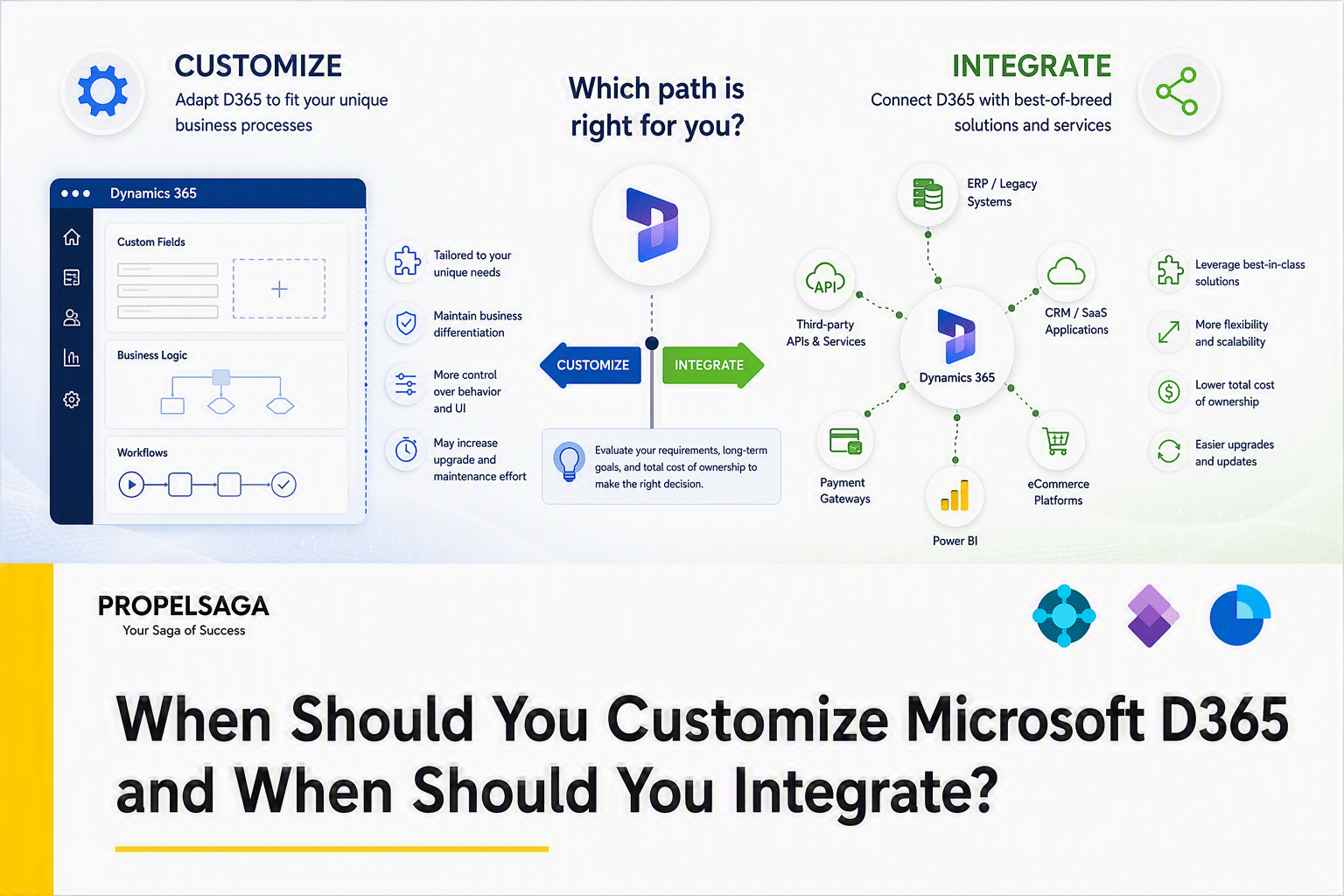
One of the most important decisions in a Microsoft Dynamics 365 implementation is knowing when to customize and when to integrate.
It may seem like a technical decision, but the impact is much bigger. The wrong choice can increase implementation costs, create technical debt, complicate upgrades, and make the system harder to maintain.
The right question is not “Can we customize Microsoft D365?” but “What is the most sustainable way to achieve the business outcome?”
When Should You Customize?
Customization makes sense when the requirement is core to your business and cannot reasonably be addressed through standard Microsoft D365 capabilities.
Consider customization when:
- The process gives your business a competitive or operational advantage.
- Standard Microsoft D365 functionality cannot adequately support the requirement.
- The process needs to work closely within Microsoft D365.
- The long-term business value justifies the additional maintenance and support.
However, customization should not be the first response to every gap. Before building something new, organizations should evaluate configuration, standard functionality, and available extensions.
When Should You Integrate?
Integration is often the better approach when another application already performs a specialized function effectively.
For example, organizations may choose to integrate Microsoft D365 with e-commerce platforms, payment systems, payroll applications, logistics platforms, banking systems, or industry-specific solutions.
Integration makes sense when:
- A specialized system already does the job better.
- The existing application is a strategic investment.
- Multiple systems need to share data.
- The capability needs to evolve independently of the ERP.
The Bigger Business Question
Over customization can make Microsoft D365 expensive and difficult to evolve.
Over integration can create another problem: complex architecture, data synchronization challenges, and multiple points of failure.
The goal is therefore not to minimize customization or maximize integration.
The goal is to create the right balance.
Let Microsoft D365 do what it does best. Let specialized applications do what they do best. And use integration to connect them intelligently.
Before making the decision, leadership should ask:
- Is this capability strategic to our business?
- Can Microsoft D365 handle it effectively?
- Does another system already do it better?
- What will this decision cost us to maintain over the next 3–5 years?
A successful Microsoft D365 implementation is not simply about going live. It is about creating an architecture that can scale, adapt, and deliver value long after implementation.
At PropelSaga, we help organizations evaluate business requirements, D365 capabilities, integration needs, and long-term maintainability to determine the right approach.
The best Microsoft D365 architecture isn't the one with the least customization or the most integrations. It's the one that creates the least unnecessary complexity while delivering the greatest business value.