
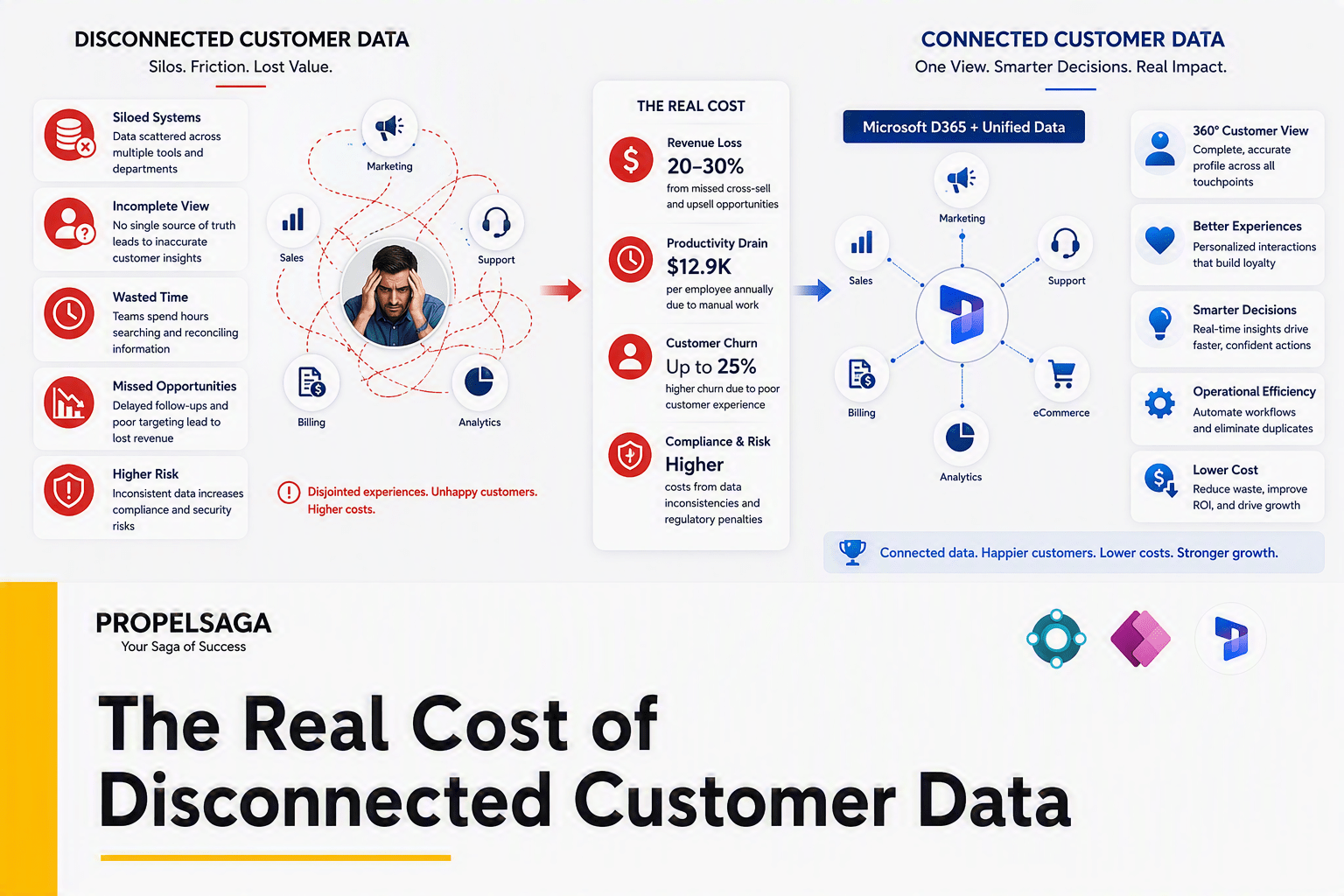
Customer data has become one of the most valuable assets for modern businesses. Every interaction from a sales enquiry and marketing campaign to a customer service case and invoice creates information that can help a business understand its customers better.
But there is a challenge that many organizations continue to face:
Customer data is often spread across disconnected systems.
Sales may use a CRM system, customer service may maintain separate case records, marketing may work with another platform, while finance and operations manage customer information in their ERP.
Each system may work well independently. The real problem begins when these systems don't communicate effectively with each other.
What Happens When Customer Data Is Disconnected?
Disconnected data creates more than an IT problem. It directly affects how teams operate and how customers experience the business.
1. Incomplete Customer Visibility
A sales representative may know a customer's opportunity history but have limited visibility into their support cases or financial relationship.
Similarly, a customer service representative may see an open support case without having the complete context of the customer's purchases, contracts, or previous interactions.
Without a unified view, employees have to piece information together from different systems.
2. More Manual Work
When systems are disconnected, employees often depend on spreadsheets, emails, manual exports, and repetitive data entry to move information between teams.
This consumes valuable time and also creates opportunities for:
- Duplicate records
- Incorrect information
- Delayed updates
- Data-entry errors
- Different versions of customer information
The more manual the process becomes, the harder it is to maintain reliable data.
3. Missed Sales Opportunities
Customer data can reveal opportunities that may otherwise remain hidden.
For example, a customer purchasing one product may also be a potential buyer of another service. But if sales cannot easily access the customer's complete history, identifying these opportunities becomes difficult.
Disconnected data can therefore prevent organizations from getting the full value from existing customer relationships.
4. Inconsistent Customer Experience
Customers don't think in terms of departments.
They expect the company to know who they are, what they have purchased, what issues they have raised, and what conversations they have already had.
When information is scattered across systems, customers may have to repeat the same information to different employees.
Over time, this can affect trust and customer satisfaction.
How Microsoft D365 Helps Connect the Customer Journey
Microsoft D365 provides a connected ecosystem of business applications that can help organizations bring customer, sales, service, and financial processes together.
Microsoft D365 Sales
Microsoft D365 Sales provides sales teams with a centralized view of leads, opportunities, accounts, contacts, activities, and interactions.
Instead of relying on disconnected spreadsheets and emails, sales teams can work from a common source of customer information and track the complete opportunity lifecycle.
Microsoft D365 Customer Service
Customer service teams can use Microsoft D365 Customer Service to manage cases, customer interactions, knowledge, and service processes.
When connected with other Microsoft D365 applications, service teams can gain greater context about the customer rather than viewing a support issue in isolation.
Microsoft D365 Customer Insights
Customer data becomes even more valuable when organizations can bring information from different sources together.
Microsoft D365 Customer Insights
helps organizations create a more unified understanding of customers and use that information for more relevant engagement and personalized experiences.
Microsoft D365 Business Central
Customer relationships don't stop with CRM.
Financial and operational information can also provide important customer context.
Microsoft D365 Business Central helps organizations manage areas such as finance, sales, purchasing, inventory, and operations. Connecting this information with customer-facing processes can give businesses greater visibility across the customer lifecycle.
Microsoft Power Platform
Not every organization has identical processes.
This is where Microsoft Power Platform can complement Microsoft D365 through:
- Power Apps for custom business applications
- Power Automate for workflow automation
- Power BI for reporting and analytics
- Copilot capabilities for AI-assisted business processes
Together, these technologies can help organizations connect processes that may otherwise remain fragmented.
Connected Data Is About More Than Technology
Implementing a CRM or ERP system alone does not automatically solve the problem of disconnected data.
Organizations also need to consider:
Data quality: Is customer information accurate and consistent?
Integration: Can systems exchange information effectively?
Process design: Do departments follow connected processes?
User adoption: Are employees actually using the system consistently?
Governance: Who owns and maintains customer data?
A successful transformation therefore requires both technology and a clear business strategy.
From Disconnected Data to Connected Decisions
The real value of connected customer data isn't simply having all information in one place.
It is being able to turn that information into better business decisions.
When sales understand service history, when service understands customer value, when marketing understands customer interactions, and when management has visibility across the business, teams can operate with greater context.
Connected data creates connected teams.
Connected teams create better customer experiences.
And better customer experiences create stronger business relationships.
The question for organizations today isn't simply:
"Where is our customer data?"
It is:
"Can our teams actually connect the information they already have and use it effectively?"
How PropelSaga Can Help
At PropelSaga, we help Microsoft partners and organizations strengthen their Microsoft D365 and Power Platform capabilities.
Our expertise spans Dynamics 365 Sales, Customer Service, Business Central, Power Platform, integrations, implementation support, and ongoing managed services.
Whether the requirement is connecting existing systems, extending Dynamics 365 capabilities, building Power Platform solutions, or supporting a broader Microsoft Business Applications initiative, our teams can work alongside your existing technology and delivery teams.
Because connected customer data isn't just an IT initiative it is a foundation for better customer relationships and better business decisions.