
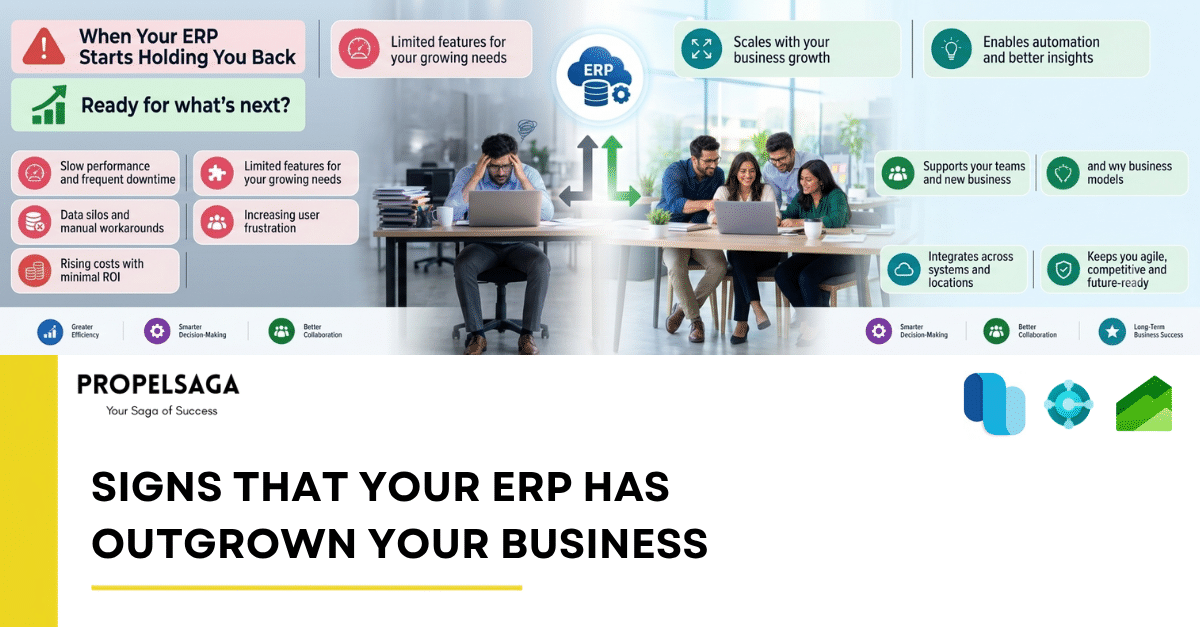
An ERP system is supposed to make a business more efficient as it grows. But sometimes, the same system that supported your business for years can eventually become a constraint.
As operations expand, processes become more complex, teams increase, and customer expectations rise. An ERP that once worked perfectly may start requiring workarounds, spreadsheets, manual processes, and constant customization.
The question is not simply “Is our ERP old?”
The more important question is:
“Is our ERP still capable of supporting the way our business operates today and where we want to go next?”
Here are some signs that your ERP may have outgrown your business.
1. Your Teams Depend Too Much on Excel
Excel is useful for analysis and reporting, but it becomes a warning sign when employees regularly export ERP data into spreadsheets just to complete basic business processes.
If teams are maintaining separate spreadsheets for inventory, sales, purchasing, finance, forecasting, or customer information, your ERP may no longer be providing the visibility your business needs.
The more your business depends on offline spreadsheets, the greater the risk of:
- Duplicate data
- Manual errors
- Outdated information
- Version conflicts
- Time-consuming reconciliation
2. Too Many Processes Are Manual
As a business grows, manual processes become increasingly expensive.
If employees are manually entering the same information into multiple systems, sending approval emails, preparing reports manually, or repeatedly transferring data between applications, your ERP may not be supporting your operational requirements effectively.
Modern ERP platforms should help automate repetitive processes and reduce unnecessary human intervention.
3. Your ERP Requires Constant Workarounds
One of the clearest signs of an aging or inadequate ERP is the number of workarounds employees have created.
You may hear statements such as:
- “We do this outside the ERP.”
- “There is a workaround for that.”
- “We export the data and process it manually.”
- “Only one person knows how to do this.”
- “The system cannot handle that process.”
When workarounds become part of everyday operations, they can indicate that the ERP no longer fits the business.
4. Reporting Takes Too Long
Business leaders need timely information to make decisions.
If producing a management report requires exporting data, combining multiple spreadsheets, manually cleaning information, and waiting several days for the final numbers, your ERP may not be providing sufficient visibility.
Growing businesses typically need faster access to information across areas such as:
- Financial performance
- Sales pipeline
- Inventory
- Purchasing
- Customer activity
- Project profitability
- Operational performance
Good reporting should support decision-making—not become a project of its own.
5. Your Business Processes Have Become More Complex
Your ERP may have been perfectly suited to your business when you were smaller.
But growth introduces complexity.
You may now have:
- Multiple locations
- Multiple legal entities
- International operations
- More complex supply chains
- Larger product portfolios
- More sophisticated financial requirements
- New sales channels
- Greater regulatory requirements
If your ERP struggles to accommodate these changes without significant customization or manual intervention, it may have reached its limits.
6. Employees Are Working Around the ERP
Technology adoption is often a useful indicator of whether an ERP is still meeting business needs.
If employees regularly avoid using the ERP because they find it slow, complicated, difficult to navigate, or incapable of supporting their processes, the problem may not simply be user resistance.
Sometimes, the system itself has become misaligned with the way the organization works.
A growing gap between how the business operates and how the ERP operates should not be ignored.
7. Integrations Are Becoming a Problem
Businesses rarely operate on one system anymore.
ERP platforms often need to connect with CRM, e-commerce, payroll, banking, warehouse, logistics, reporting, and other business applications.
If integrations are becoming increasingly difficult to maintain, data is frequently inconsistent between systems, or employees are manually transferring information between applications, your ERP architecture may need to be reconsidered.
8. Customizations Are Becoming a Burden
Customization can solve specific business requirements, but excessive customization can create long-term complexity.
Over time, organizations may accumulate custom workflows, modifications, reports, integrations, and extensions.
Eventually, maintaining these customizations can become expensive and make upgrades more difficult.
The question should not be:
“Can we customize the ERP to do this?”
Instead, businesses should ask:
“Is customization still the right approach for this requirement?”
9. Your ERP Cannot Easily Support New Business Models
Growth often means changing the way a company does business.
You may introduce new products, subscription models, digital channels, new services, international operations, or different fulfillment models.
If your ERP makes every new initiative difficult to implement, it may be restricting business growth rather than enabling it.
A modern ERP should provide a foundation that allows the business to evolve.
10. Your ERP Vendor or Technology Is Becoming a Constraint
Sometimes the challenge is not your internal processes but the technology itself.
If your ERP has limited integration capabilities, weak reporting, poor scalability, outdated architecture, or limited support for modern cloud and AI capabilities, continuing to invest heavily in it may not be the best long-term strategy.
Technology should enable your roadmap—not force your roadmap to fit the technology.
11. Your ERP Is Increasing the Cost of Doing Business
An ERP should ultimately improve efficiency.
If maintaining the system requires excessive consulting, customization, manual reconciliation, specialized technical expertise, or multiple disconnected applications, the total cost of ownership may be much higher than it appears.
The real cost of an ERP is not only its license or subscription.
It also includes the cost of:
People + Processes + Customizations + Integrations + Maintenance + Inefficiency
12. Your Business Has Outgrown Its Visibility
Perhaps the biggest warning sign is when leadership cannot confidently answer basic business questions.
For example:
- What is our true inventory position?
- Which products are most profitable?
- Where are our biggest operational bottlenecks?
- Which customers are generating the most value?
- What is our cash position?
- Where are orders getting delayed?
- What will demand look like over the next few months?
If answering these questions requires multiple reports, spreadsheets, and manual analysis, your ERP may no longer provide the visibility your business needs.
Does This Mean You Need a New ERP?
Not necessarily.
An ERP that feels inadequate does not automatically need to be replaced.
Sometimes the real problem is:
- Poor configuration
- Low user adoption
- Outdated processes
- Lack of integration
- Missing automation
- Poor reporting
- Excessive customization
- Insufficient training
In other cases, the underlying ERP platform genuinely cannot support the organization's current or future requirements.
The right approach is to first assess the gap between your business requirements and your existing ERP capabilities.
Only then should you decide whether to optimize, integrate, modernize, or replace the system.
The Goal Is Not a New ERP. It Is a Better Business.
ERP transformation should not be treated simply as a technology upgrade.
The objective should be to create a business environment where information flows efficiently, processes are connected, employees can work productively, and leadership has the visibility needed to make better decisions.
Platforms such as Microsoft D365 Business Central and Microsoft D365 Finance & Supply Chain Management can provide a scalable foundation for growing operations.
At PropelSaga, we help Microsoft partners and businesses evaluate, modernize, integrate, and extend their Microsoft D365 capabilities helping organizations move from fragmented processes toward a more connected and scalable business environment.
The right ERP should not simply keep up with your business. It should help your business move forward.