
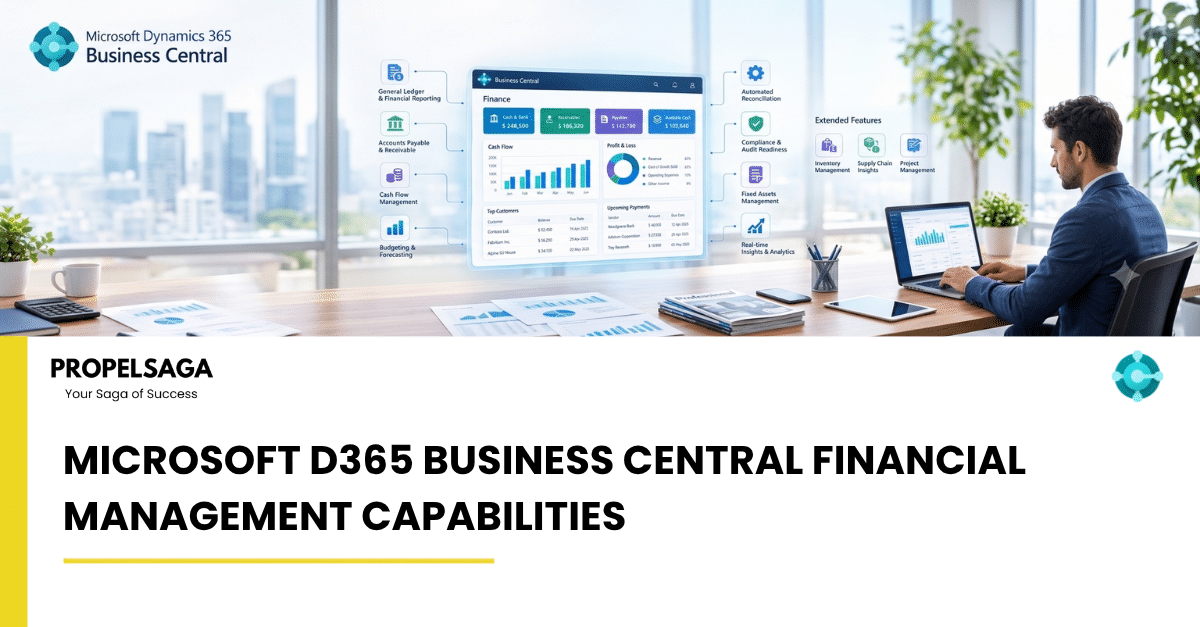
Financial management is one of the most critical functions of any business. Every organization needs to know where its money is coming from, where it is being spent, what it owes, what customers owe, and whether the business is moving in the right financial direction.
However, as businesses grow, managing these activities through spreadsheets, disconnected accounting systems, and manual processes becomes increasingly difficult.
This is where Microsoft D365 Business Central can make a significant difference.
Microsoft D365 Business Central brings accounting and financial management together with sales, purchasing, inventory, projects, and other business processes. Instead of finance operating as a separate function, financial information becomes connected to the activities that generate it.
From Accounting Records to Financial Visibility
Traditional accounting systems often focus primarily on recording transactions. While accurate accounting is essential, modern businesses need more than historical financial records.
Management wants to understand:
- Which areas of the business are profitable?
- Where are costs increasing?
- Which customers have outstanding payments?
- How much cash is available?
- Are departments staying within their budgets?
- How are different locations or business units performing?
Microsoft D365 Business Central helps organizations answer these questions by connecting financial information with operational data.
When a sales order, purchase, inventory transaction, or other business activity takes place, the related financial impact can flow into the organization's financial records.
This creates a more complete picture of business performance.
Managing the Financial Foundation
At the core of Microsoft D365 Business Central is a comprehensive financial management framework.
Organizations can manage general ledger transactions, chart of accounts, journals, accounts payable, accounts receivable, bank accounts, taxes, and other core accounting activities from one system.
This reduces the need to maintain financial information across multiple disconnected applications.
For finance teams, the benefit is not simply fewer systems. It is having a more consistent and accessible source of financial information.
Better Control Over Accounts Receivable and Payable
Cash flow can become a major concern when businesses grow.
A company may have strong sales but still experience cash-flow pressure because customers are paying late while vendor payments continue to become due.
Microsoft D365 Business Central helps finance teams manage customer and vendor transactions, payment terms, outstanding balances, invoices, and related financial activities.
With better visibility into receivables and payables, businesses can identify overdue amounts and make more informed decisions about their cash position.
Understanding Financial Performance Through Dimensions
A company's overall profit and loss statement does not always tell the complete story.
For example, management may want to know how different branches, departments, projects, or business units are performing.
Microsoft D365 Business Central's financial dimensions allow organizations to add additional context to financial transactions.
Instead of looking only at an expense account, a business can analyse that expense by department, location, project, or another relevant dimension.
This can help management move from simply asking "What did we spend?" to asking "Where and why did we spend it?"
Turning Budgets into Meaningful Business Information
Budgeting is another important part of financial management.
Businesses create budgets to establish financial expectations, but the real value comes from comparing those expectations with actual performance.
Microsoft D365 Business Central can help organizations analyse budget versus actual figures and identify significant variances.
For example, if a department's expenses are consistently higher than planned, management can investigate the reason rather than discovering the issue only at the end of the financial year.
This makes budgeting a more active part of financial decision-making.
Better Cash and Bank Management
Cash is the lifeblood of a business, and having an accurate understanding of cash position is essential.
Microsoft D365 Business Central provides capabilities for managing bank accounts, recording transactions, and reconciling bank activity with financial records.
A more structured reconciliation process can reduce manual effort and help finance teams identify differences between bank transactions and accounting records.
The objective is simple: give the business greater confidence in its financial position.
Managing Assets Beyond the Balance Sheet
For businesses with significant investments in equipment, machinery, vehicles, buildings, or other assets, fixed asset management is another important consideration.
Microsoft D365 Business Central supports the financial management of fixed assets, including acquisition, depreciation, and disposal.
This helps organizations maintain a structured view of their assets and their financial impact over time.
Supporting Businesses Operating Across Countries
For organizations working internationally, financial management can become more complex.
Different currencies, companies, customers, vendors, and transactions introduce additional challenges.
Microsoft D365 Business Central supports multi-currency financial operations and intercompany processes, helping organizations manage financial activities across different entities and markets.
This makes the platform suitable not only for single-entity businesses but also for organizations with more complex structures.
The Real Advantage: Connecting Finance with Operations
Perhaps the biggest strength of Microsoft D365 Business Central is that financial management does not exist separately from the rest of the business.
Consider a simple purchasing process.
A business purchases goods from a supplier. That transaction can affect purchasing, inventory, accounts payable, cash flow, and ultimately financial reporting.
Similarly, a customer sale can connect sales, inventory, receivables, revenue, and financial reporting.
Instead of finance teams waiting for information from different departments, the data can flow through a connected ERP environment.
That is where Microsoft D365 Business Central moves beyond being simply an accounting system.
Making Better Decisions with Better Financial Data
The ultimate purpose of financial management is not just to maintain accurate books.
It is to help the business make better decisions.
When management has timely and reliable financial information, it becomes easier to identify trends, control costs, understand profitability, monitor cash flow, and plan future investments.
Microsoft D365 Business Central provides the foundation for this by bringing financial and operational information together.
Is Your Business Using Microsoft D365 Business Central to Its Full Potential?
Many organizations implement Microsoft D365 Business Central to address their immediate accounting and ERP requirements. Over time, however, they may discover that the platform offers financial capabilities that can support much broader business needs.
The opportunity is not to activate every feature simply because it exists.
The better approach is to understand the organization's financial processes, identify gaps, and configure Microsoft D365 Business Central around the way the business actually operates.
Microsoft D365 Business Central can provide much more than financial record-keeping. When implemented and utilized effectively, it can become a connected financial management platform that gives businesses greater control, visibility, and confidence in their decisions.
How PropelSaga Can Help
At PropelSaga, we help Microsoft partners strengthen their Microsoft D365 Business Central capabilities with implementation expertise, functional and technical capabilities, team extension, and ongoing support.
Whether the requirement is financial management, optimization of an existing Microsoft D365 Business Central environment, or broader ERP transformation, the right combination of technology and expertise can help businesses get significantly more value from their Microsoft D365 Business Central investment.