
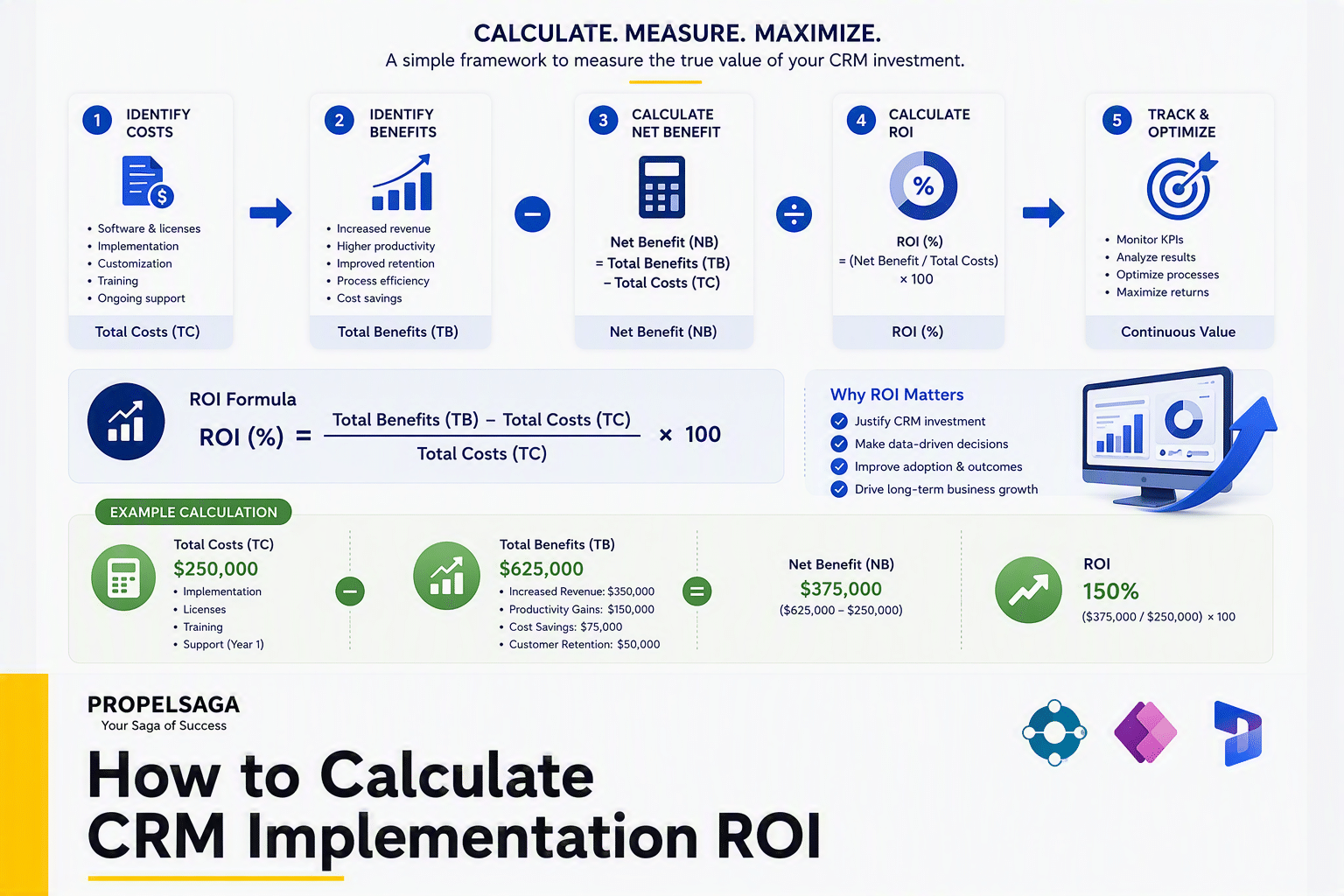
Implementing a CRM is a significant investment. Beyond software licenses, businesses may spend on implementation, customization, data migration, integrations, training, and ongoing support.
But the real question is: Is the CRM generating enough business value to justify the investment?
Calculating CRM ROI helps businesses answer this question using measurable financial and operational results.
What Is CRM ROI?
CRM ROI measures the value generated by a CRM compared with the total cost of implementing and operating it.
CRM ROI = [(Total Benefits − Total CRM Costs) ÷ Total CRM Costs] × 100
For example, if a company invests ₹20 lakh in CRM and generates ₹40 lakh in measurable benefits:
ROI = [(₹40L − ₹20L) ÷ ₹20L] × 100 = 100%
1. Calculate the Total CRM Cost
Don't consider only the license cost. Include:
- CRM licenses
- Implementation and configuration
- Data migration
- Integrations
- Customization
- Employee training
- Support and maintenance
This provides a realistic view of the overall investment.
2. Measure Revenue Improvement
A CRM can contribute to revenue growth by improving lead management, follow-ups, opportunity tracking, and sales visibility.
Important metrics include:
- Lead conversion rate
- Win rate
- Average deal size
- Pipeline value
- Sales cycle
For example, if better lead management increases conversion from 10% to 13%, the additional customers and revenue can be included when calculating CRM benefits.
3. Calculate Productivity Savings
CRM automation can reduce time spent on manual activities such as data entry, reporting, follow-ups, and updating spreadsheets.
For example, if 20 salespeople save 3 hours per week:
20 × 3 × 52 = 3,120 hours saved annually
The financial value of this saved time can be calculated using the organization's employee cost per hour.
4. Measure Customer Retention
CRM ROI is not only about acquiring new customers. Better customer information and proactive engagement can help businesses improve retention and reduce churn.
Track metrics such as:
- Customer retention
- Churn rate
- Renewals
- Cross-selling
- Upselling
- Customer lifetime value
Even a small improvement in retention can protect significant recurring revenue.
5. Track CRM Adoption
A CRM can only generate value when employees actually use it.
Businesses should monitor:
- Active users
- Opportunities updated regularly
- Follow-ups completed
- Data completeness
- Usage of CRM workflows and automation
Implementation creates the system. Adoption creates the value.
A Simple Example
Suppose a company invests ₹25 lakh in CRM implementation.
After implementation, it generates:
- ₹25 lakh from additional sales
- ₹10 lakh in productivity savings
- ₹5 lakh from improved customer retention
Total measurable benefit = ₹40 lakh
Therefore:
CRM ROI = [(₹40L − ₹25L) ÷ ₹25L] × 100 = 60%
This means the organization generated ₹15 lakh in net measurable value against its ₹25 lakh investment.
How Microsoft Dynamics 365 Can Help
Microsoft Dynamics 365 can help organizations improve sales and customer management through capabilities such as:
- Lead and opportunity management
- Sales pipeline visibility
- Forecasting
- Workflow automation
- Customer insights
- Reporting and dashboards
- Cross-selling and upselling
The objective should not simply be to implement CRM features. The implementation should be connected to specific business goals and measurable KPIs.
Final Thoughts
CRM ROI should not be measured only by software cost versus revenue. Businesses should consider revenue growth, productivity, customer retention, sales efficiency, and user adoption.
The most important question is not:
"How much does the CRM cost?"
It is:
"What measurable business improvement will the CRM create?"
How PropelSaga Can Help
PropelSaga helps organizations implement and enhance Microsoft Dynamics 365 CRM solutions aligned with their business processes and objectives.
From CRM implementation and integration to process automation and ongoing support, our focus is on helping businesses turn their CRM investment into measurable business value.