
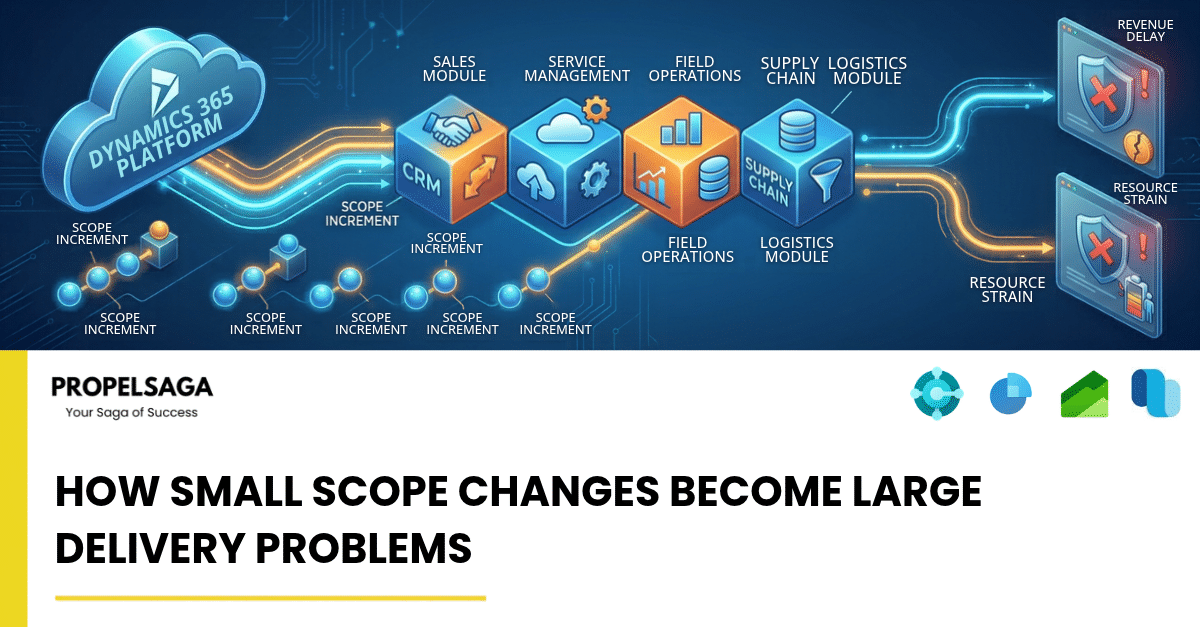
In technology projects, the biggest delivery challenges don't always begin with major changes. Sometimes, they start with a simple request that nobody considers significant.
A customer asks for one additional field in a report. Another requests a minor modification to an approval workflow. A third wants an existing business process to behave slightly differently.
Individually, these requests appear harmless. They may take only a few hours to implement, and the delivery team often agrees to accommodate them without much discussion.
But over time, these small changes begin to accumulate.
What initially appeared to be a straightforward implementation gradually becomes more complicated. Testing takes longer, dependencies increase, timelines become uncertain, and the delivery team finds itself managing expectations that were never part of the original project plan.
This is how small scope changes become large delivery problems.
1. The Problem Is Not the Change, but the Accumulation
Scope changes are a natural part of technology projects. Business requirements evolve, users discover new possibilities, and implementation teams gain a better understanding of operational needs.
The challenge arises when every individual request is evaluated in isolation.
Consider a Microsoft Dynamics 365 Business Central implementation.
- A customer requests an additional field on a purchase order.
- Another request introduces a new approval condition.
- A report needs additional filtering options.
- An existing workflow requires an exception.
- A new validation rule is introduced during UAT.
Each request might seem manageable. However, together they can affect configurations, extensions, integrations, data flows, testing scenarios, and documentation.
The actual effort is rarely limited to the time required to develop the requested change.
The cumulative impact is often much greater than the individual effort of each request.
2. Small Changes Create Hidden Dependencies
One of the most overlooked aspects of scope changes is their impact on connected processes.
In modern ERP and CRM environments, business functions rarely operate independently.
A seemingly minor change in one area can influence several others.
For example, modifying a purchase approval process may affect:
- Purchase order processing.
- Approval hierarchies.
- User permissions.
- Notifications and Power Automate flows.
- Financial posting controls.
- Regression testing.
The development effort might be small, but the validation effort can be significantly larger.
This is particularly relevant in Microsoft Dynamics 365 projects, where Business Central, Finance & Operations, Sales, Power Platform, and third-party integrations often operate as interconnected components.
A change that looks local from a business user's perspective may have implications across the wider solution.
3. Unrecorded Changes Gradually Become Scope Creep
Not every scope change enters a project through a formal change request.
Some arrive during meetings. Others appear in emails, Teams conversations, testing feedback, or informal discussions between customers and consultants.
When these requests are implemented without proper documentation, three problems emerge:
Unclear expectations: The customer may assume the change was included in the original commitment, while the delivery team considers it an additional activity.
Uncontrolled effort: The project team spends time on activities that were never accounted for in the original estimates.
Accountability gaps: When timelines or deliverables are questioned, it becomes difficult to establish when and why the additional work was introduced.
Over time, the project loses visibility into what was originally agreed upon and what has been added along the way.
4. The Real Cost Is Often Seen During Testing and Go-Live
The impact of uncontrolled scope changes is not always immediately visible during development.
It often becomes apparent during User Acceptance Testing (UAT), integration testing, and go-live preparation.
A small modification may require additional test cases. A workflow adjustment may affect previously validated scenarios. A new business rule may require changes to user training and documentation.
Consequently, teams experience:
- Repeated testing cycles.
- Delayed UAT sign-offs.
- Increased coordination between functional and technical teams.
- Additional deployment activities.
- Greater pressure on go-live timelines.
The result is a project where the delivery team is continuously working, but the overall completion date keeps moving.
Being busy is not the same as making progress.
5. How Delivery Teams Can Manage Scope Changes Better
The objective should never be to reject every additional customer request. A rigid approach can prevent a solution from evolving with genuine business needs.
Instead, organizations need a structured approach to evaluating and managing changes.
Establish a clear baseline
Document the agreed requirements, deliverables, assumptions, exclusions, timelines, and responsibilities before implementation begins.
Evaluate the complete impact
Before accepting a change, assess its functional, technical, integration, testing, and deployment implications. Do not evaluate effort only from a development perspective.
Introduce a change control process
Every significant change should have a documented request, impact assessment, approval, and revised estimate where applicable.
Prioritize business value
Not every request needs to be implemented immediately. Distinguish between essential go-live requirements, operational improvements, and enhancements that can be delivered in a subsequent phase.
Maintain continuous communication
Customers and delivery teams should have a shared understanding of how changes affect timelines, costs, priorities, and commitments.
A transparent conversation early in the project is far less expensive than resolving disagreements near go-live.
6. Delivery Discipline Is as Important as Technical Capability
Successful technology implementation is not determined by how quickly a team can develop a feature or configure a business process.
It also depends on how effectively the team manages decisions, dependencies, priorities, and expectations.
Even technically strong teams can struggle when project boundaries are unclear and changes are accepted without evaluating their broader implications.
For technology partners, delivery discipline becomes particularly important when managing multiple projects, distributed teams, and customer expectations across different time zones.
The ability to manage change without losing control of delivery is a critical part of project maturity.
Final Thoughts: Small Decisions Shape Large Outcomes
Scope changes are not inherently bad. In fact, they are often necessary to deliver solutions that genuinely address business requirements.
The problem begins when small changes are treated as insignificant decisions rather than evaluated as part of the larger delivery commitment.
A project rarely goes off track because of one additional field, one modified workflow, or one extra report.
It is more often the cumulative effect of multiple decisions made without sufficient visibility, assessment, or control.
The best delivery teams are not those that say yes to every request. They are those that understand the implications of every yes.
At PropelSaga, we believe successful Microsoft Dynamics 365 delivery requires more than technical expertise. It requires structured execution, experienced functional and technical teams, and the discipline to manage changing business requirements without compromising delivery commitments.
Whether it is Business Central, Finance & Operations, or the wider Microsoft Business Applications ecosystem, the right delivery approach makes the difference between simply completing tasks and delivering successful projects.
PropelSaga – Your Saga of Success.