
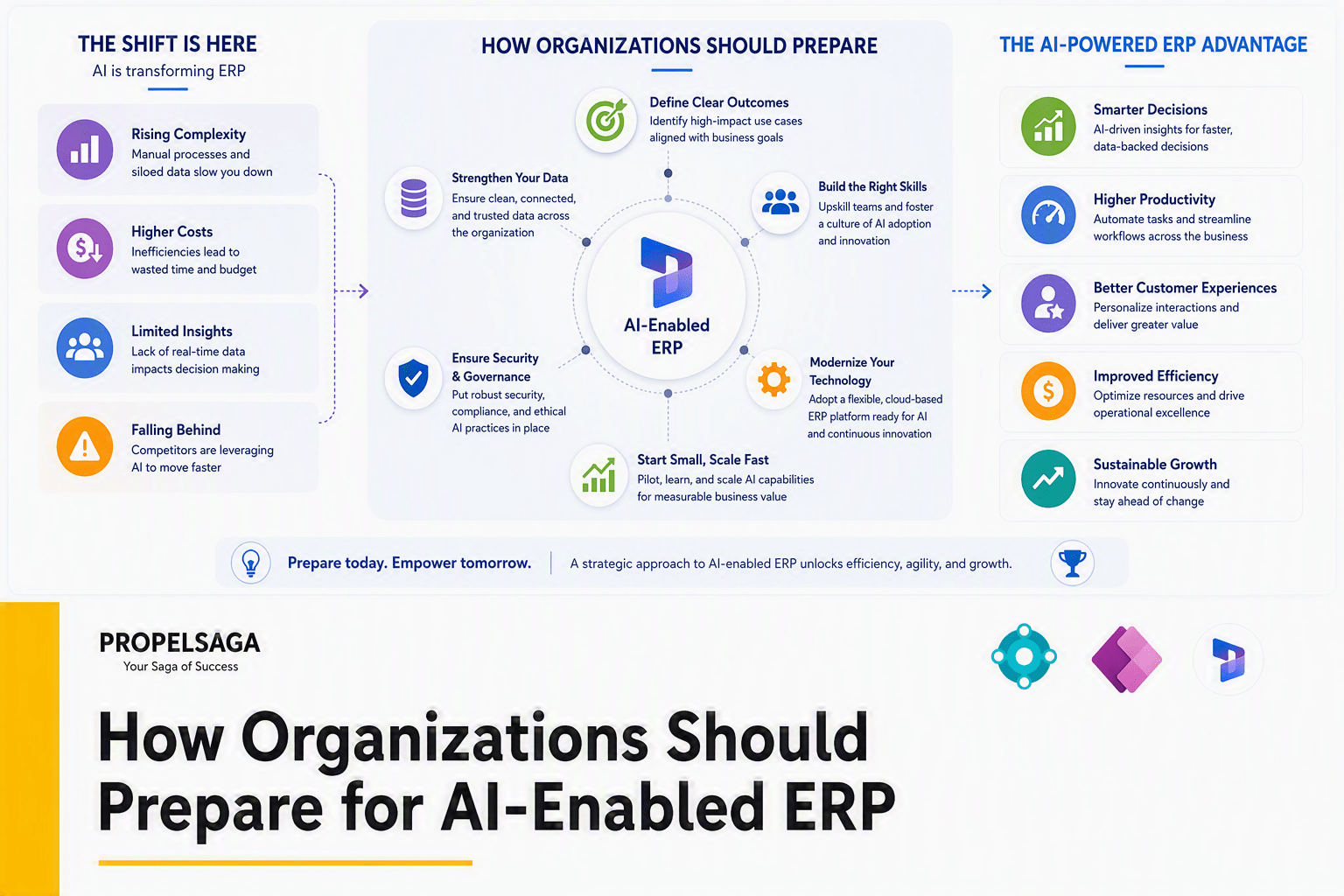
Artificial intelligence is becoming an important part of modern ERP systems. From automating repetitive tasks to generating insights and supporting business decisions, AI is changing how organizations use ERP platforms.
However, adopting AI is not simply about enabling new features. Organizations need the right data, processes, technology, and people to make AI useful.
So, how can organizations prepare for an AI-enabled ERP environment?
1. Start With Business Problems
Organizations should begin by identifying areas where AI can create measurable business value.
For example:
- Finance teams spending too much time on manual analysis
- Sales teams manually updating customer information
- Supply chain teams struggling with forecasting
- Employees searching across multiple systems for information
- Customer service teams handling repetitive queries
Instead of adopting AI because it is a trend, organizations should identify specific problems where AI can improve productivity, automate activities, or support better decisions.
2. Improve Data Quality
AI depends heavily on the quality of the data it uses.
ERP systems often contain years of customer, vendor, financial, sales, purchasing, and inventory data. If this information is incomplete, duplicated, outdated, or inconsistent, AI may not deliver reliable insights.
Organizations should therefore focus on:
- Clean master data
- Consistent data structures
- Removing duplicate records
- Clear data ownership
- Data security and governance
AI can process large amounts of data, but better data creates a stronger foundation for better outcomes.
3. Simplify Business Processes
AI should not simply automate inefficient processes.
Organizations should first identify where processes can be simplified and standardized.
For example, if a purchase approval requires spreadsheets, emails, and multiple manual entries, the organization should first improve the workflow before introducing AI.
Businesses should ask:
- Which activities are repetitive?
- Where is manual data entry required?
- Where do approvals get delayed?
- Which processes can be automated?
- Where are employees dependent on spreadsheets?
A simpler process makes it easier to introduce automation and AI.
4. Modernize the ERP Environment
Many organizations operate ERP environments that have developed over several years and may include legacy applications, customizations, spreadsheets, and disconnected systems.
Before introducing AI, organizations should evaluate:
- ERP version and capabilities
- Existing customizations
- Integrations
- Legacy systems
- Reporting infrastructure
- Manual workarounds
Modern ERP platforms such as Microsoft Dynamics 365 increasingly bring AI capabilities into everyday business processes.
A modern and well-connected ERP environment can therefore provide a stronger foundation for AI adoption.
5. Connect Business Applications
AI becomes more useful when it has access to the right business context.
For example, connecting CRM, ERP, supply chain, finance, and customer service systems can give employees a more complete view of customers and operations.
Microsoft Dynamics 365 and Power Platform can help organizations connect business applications, data, workflows, and users.
The objective is not simply to connect more systems. It is to ensure that employees can access relevant information when they need it.
6. Prepare Employees for AI
AI-enabled ERP will change how employees work.
Instead of spending most of their time on repetitive activities, employees may increasingly review AI-generated insights, manage exceptions, and focus on decision-making.
Organizations should therefore provide employees with:
- AI awareness
- ERP training
- Role-specific training
- Guidelines for using AI
- Training on validating AI-generated information
Successful AI adoption requires both technology and employee adoption.
7. Establish AI Governance
ERP systems contain important business information, so AI adoption should include appropriate governance.
Organizations should define rules around:
- Data access
- Security and privacy
- User permissions
- Human approvals
- AI-generated recommendations
- Sensitive information
Not every AI recommendation should automatically result in a business action. Organizations should determine which activities can be automated and which require human review.
8. Start Small and Measure Results
Organizations do not need to introduce AI across the entire ERP environment immediately.
A practical approach is to start with one or two high-value use cases, measure the results, and then expand.
Success can be measured through:
- Time saved
- Reduced manual work
- Faster processing
- Fewer errors
- Improved forecasting
- Better employee productivity
This allows organizations to connect AI investments with measurable business outcomes.
Building an AI-Ready ERP
Preparing for AI-enabled ERP requires more than implementing new technology.
Organizations should focus on five foundations:
Quality Data → Standardized Processes → Modern ERP → Connected Systems → AI-Ready People
When these foundations are in place, AI can become a practical part of everyday business operations rather than simply another technology initiative.
The future of ERP is moving beyond recording transactions. ERP systems are increasingly helping organizations understand information, identify opportunities, automate activities, and support employees in making better-informed decisions.
How PropelSaga Can Help
At PropelSaga, we help Microsoft partners and organizations strengthen their Microsoft Dynamics 365 and Power Platform capabilities.
Our expertise covers Microsoft D365 Business Central, Finance & Supply Chain Management, Sales, Power Platform, integrations, ERP modernization, implementation, and managed services.
Whether an organization needs to modernize its ERP environment, connect business applications, improve implementation capabilities, or prepare for AI-enabled business applications, PropelSaga can support the journey.
AI-enabled ERP is not just about making ERP smarter. It is about preparing the organization to work effectively with intelligent technology.
PropelSaga — Your Saga of Success.