How Microsoft Dynamics 365 Commerce Supports Unified Commerce
Retailers today often sell through physical stores, e-commerce websites, mobile applications, and other sales channels. The challenge is not simply managing these channels individually. It is ensuring that inventory, pricing, customer information, orders, and financial transactions remain consistent across the business.
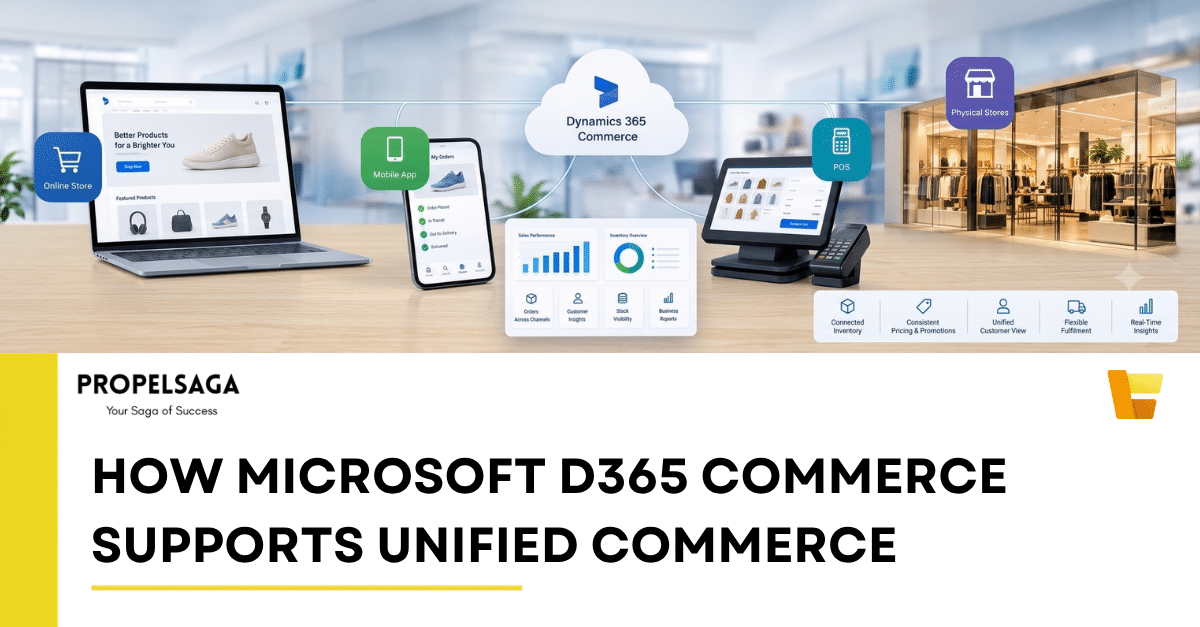
Unified commerce requires more than connecting sales channels. It requires a common operational foundation that allows the business to manage customer transactions, inventory, and order fulfilment with consistent information across channels. Microsoft Dynamics 365 Commerce supports this approach by bringing retail operations, digital commerce, and customer engagement processes into an integrated platform.
For business leaders, the objective is straightforward: improve operational visibility, reduce manual coordination, and provide customers with a consistent experience regardless of where they choose to shop.
The Core Problem and Hidden Friction
When channels run on separate systems, the extra work does not show up in any single report. It appears in several places:
- Inventory that does not match. The website shows stock that a store has already sold, or a store cannot see stock held in another location. Orders then get cancelled, delayed or substituted by hand.
- Pricing and promotions maintained more than once. Each channel needs its own update. Errors lead to customers seeing different prices for the same item and to margin lost on promotions that were applied incorrectly.
- Customer data split across systems. Purchase history, returns and loyalty balances sit in separate places. Service teams cannot see what a customer bought elsewhere, and marketing cannot tell which customers are the same person.
- Returns that depend on where the item was bought. Returning an online order in a store often needs manual lookups and approvals, and refunds get processed inconsistently.
- Integration code that needs constant maintenance. Point-to-point connections between systems break when either side is upgraded, so upgrades get delayed and cost more when they finally happen.
- Reporting that takes days to assemble. Finance and operations teams export data from each system and reconcile it in spreadsheets, so leadership decisions rest on figures that are already out of date.
Traditional approaches fail because they add integrations between systems that were never designed to share a common model for products, customers and orders. Each integration copies data on a schedule, so the systems are always slightly out of step. Adding more of them increases the number of places where a mismatch can occur.
The Business Comparison
Consider two mid-sized retailers, each with about 80 stores, an e-commerce site and a customer service team.
Company A runs a separate point-of-sale system in stores, a separate e-commerce platform and a back-office system connected to both through scheduled file transfers. Inventory is updated to the website every few hours. Promotions are entered separately in each system. When a customer buys online and wants to return the item in a store, the store associate calls the online team to verify the order.
In practice, the website sells items that are no longer available, and the customer service team spends time on cancellations and apologies. Pricing corrections are handled by the merchandising team after customers report mismatches. Finance closes the month later because sales from each channel must be reconciled before reporting. Any change to the e-commerce platform requires testing every integration, so updates are postponed.
Company B runs Microsoft Dynamics 365 Commerce. Stores, the website and the call center all work from the same product catalog, pricing rules, customer records and order data. Inventory is visible across locations, so the website shows what is actually available and can offer pickup in a store that has the item. Promotions are configured once and apply in every channel. A return of an online order in a store is processed at the point of sale using the original order record.
The practical differences are measurable. Company B has fewer order cancellations caused by stock errors, less staff time spent on manual lookups and corrections, a shorter financial close, and one version of sales and inventory data for leadership to use. Company B also upgrades more predictably, because the channels share one platform and the number of custom integrations is small.
The difference is not that Company B has more features. Company B has fewer places where the same information is entered and maintained.
Platform Capabilities as Supporting Evidence
The capabilities below address the friction described above. Which ones matter most depends on the business.
- Shared product and pricing management. Commerce headquarters holds the product catalog, assortments, prices and promotions centrally and distributes them to each channel. This addresses duplicate maintenance and price mismatches.
- Omnichannel inventory visibility. Inventory Visibility provides a near real-time view of stock across stores, warehouses and online. This supports accurate availability on the website, buy online pickup in store, and ordering from another location when an item is not on the shelf.
- Order management and fulfilment. Order sourcing rules can select the fulfilment location based on stock, distance or cost. This reduces manual routing and gives stores and customer service teams a single order record.
- Point of sale. The POS applications for stores support sales, returns, customer lookup, loyalty and order pickup, and can continue operating when connectivity is interrupted. Store staff can see the same customer and order information as the online and call center teams.
- E-commerce. The e-commerce module uses the same catalog, pricing, customer and order data as the stores, so the website does not need a separate copy of business data to stay current.
- Customer data and loyalty. Customer records, loyalty programs and Microsoft Dynamics 365 Customer Insights can be used together to build a single customer profile across channels. This supports consistent service and more accurate segmentation.
- Payments and fraud controls. Payment connectors and Microsoft Dynamics 365 Fraud Protection can be used to apply consistent payment handling and risk checks across online and in-store transactions.
- Power Platform and reporting. Power BI can report on sales, inventory and fulfilment from the shared data. Power Automate and Power Apps can handle approvals and exception processes without custom code in the core system, which keeps upgrades simpler.
- Integration with finance and supply chain. Commerce works with Microsoft Dynamics 365 Finance and Supply Chain Management, so retail transactions, inventory and financial postings come from the same underlying data. This is the main reason the financial close becomes shorter.
Strategic Takeaway for Leadership
Leadership should stop asking which channel needs a new capability and start asking which business data and rules need to be owned once. If products, prices, customers, inventory and orders each have a single owner and a single record, the channels become different ways of reaching the same business processes. If they do not, every new channel adds more reconciliation work.
Three decisions follow from this:
- Treat unified commerce as an operating model change. The software supports it, but the business must agree on who owns pricing, inventory policy, return rules and customer data.
- Fund data readiness as part of the project. Product, customer and inventory data that is incomplete or inconsistent will remain so after migration unless it is cleaned and mapped beforehand.
- Plan for adoption. Store staff, call center agents and merchandising teams need to work differently, and the benefits depend on them doing so.
Getting Started with PropelSaga
Implementing unified commerce requires coordination between retail operations, business stakeholders, data owners, and technology teams. PropelSaga helps organizations translate these requirements into a practical Microsoft Dynamics 365 implementation plan.
Our approach focuses on five execution areas:
- Process mapping: Understand existing retail workflows, identify operational gaps, and document the required customer and employee journeys.
- Architecture design: Plan the Microsoft Dynamics 365 Commerce environment, connected applications, integrations, and extension requirements around the organization’s business priorities.
- Data readiness: Assess product, pricing, inventory, customer, and transaction data to establish a reliable foundation for implementation.
- User training: Prepare employees for new processes through role-based training, practical scenarios, and adoption support.
- Ongoing optimization: Review operational performance, resolve implementation gaps, and identify opportunities to improve platform usage as business requirements evolve.
PropelSaga works with Microsoft Dynamics 365 and Power Platform technologies to help businesses plan, implement, and optimize solutions aligned with their operational needs.
If your retail operations rely on disconnected systems or manual coordination between online and physical stores, PropelSaga can help you assess your current environment and define a practical roadmap for Microsoft Dynamics 365 Commerce.