
Sales has always been about people. Understanding needs, building relationships, having the right conversation at the right time.
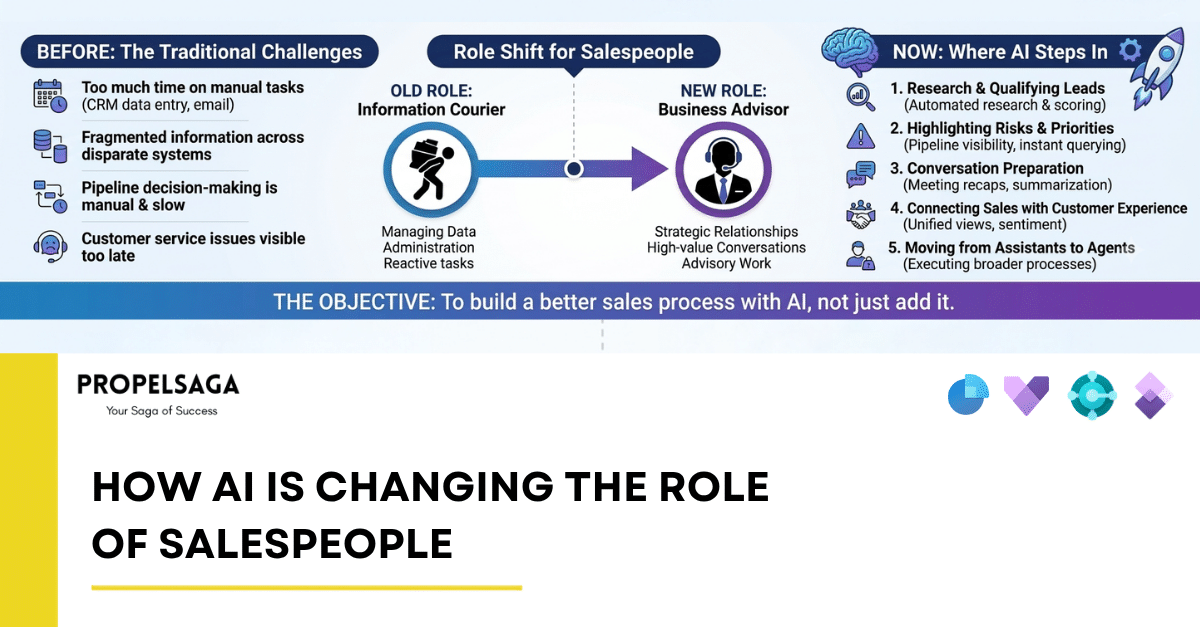
But somewhere along the way, a significant part of a salesperson's day became administration. Research suggests sellers spend only around a third of their time actually selling. The rest goes to researching prospects, updating CRM records, preparing notes, writing follow-ups and searching for customer information.
The salesperson is still responsible for the relationship, but a lot of time is spent managing the information around it.
AI is beginning to change that.
It is moving beyond being a tool that answers questions or generates content. In Microsoft's 2026 release wave, AI is no longer assistive. It is becoming part of the sales process itself, helping salespeople research, qualify, prepare, prioritise and act. The platform has shifted from a system of record, where you type in what happened, to a system of action, where AI helps move the deal forward.
The result is not simply a faster salesperson. It is a changing role for the salesperson.
The Challenges
- Too much time on activities around selling: the day starts with email, CRM updates and meeting prep before any customer conversation happens.
- Too much information, not enough context: the truth about a customer is scattered across emails, meetings, service cases and business systems, and the most recent version is often the one nobody logged.
- Too many leads to priorities manually: When the number of leads and opportunities grows, salespeople have to decide where to focus their attention. Which lead is worth pursuing? Which opportunity is at risk? Which customer needs a follow-up?
- Customer issues become visible too late: a service problem brews quietly while the sales team treats the account as business as usual, and it surfaces at the worst possible moment: the renewal conversation.
Where AI Steps In
1. Researching and qualifying leads
Lead research has traditionally required a salesperson to collect information, understand the company and decide whether the opportunity is worth pursuing.
AI can now assist with much of this preparation. A Sales Qualification Agent can ingest inbound leads, research each one, score them against your ideal-customer profile, enrich contact details, send an initial outreach email, and route the promising ones to the right salesperson.
The traditional process — Lead → Research → Qualify → Contact — becomes Lead → AI-assisted research → Salesperson review → Engagement.
The salesperson still makes the decision. But the time to reach it shrinks — and attention shifts to the opportunities that deserve it.
2. Knowing what needs attention
A sales pipeline can contain dozens of opportunities, but not every opportunity needs the same level of attention.
AI can help identify changes, risks and signals that may otherwise be missed, including changes happening outside your CRM. New Copilot capabilities draw on your CRM and your everyday Microsoft 365 activity like email threads, meeting recaps, Teams conversations, so when you open an account, the summary reflects everything that has actually happened, not just what was typed in.
You can even ask in plain English "show me all opportunities in the North region with no activity in 14 days" and get the answer instantly, no spreadsheets required.
This is where the role shifts from managing every activity to managing priorities.
3. Preparing for conversations
Good sales conversations require preparation. Salespeople need to understand what has already happened before they enter the next conversation.
AI can now summarise not just customer and opportunity records, but previous interactions, recent activities and relevant updates drawn from your emails and meetings; all in one place.
Meeting intelligence now captures notes, commitments and key moments from your calls and attaches them to the opportunity itself, so pipeline reviews run on reality instead of memory.
And a Sales Agent built into Microsoft 365 Copilot brings all of this into Outlook and Teams — the CRM now lives in the tools sellers already work in.
The important point:
AI can prepare the salesperson for the conversation. It does not replace the conversation.
4. Connecting sales with the customer experience
A customer does not interact only with the sales team. They may have support cases, field service visits, previous issues, requests or other interactions with the organization.
Customer Insights – Data unifies customer information into real-time profiles and acts as the grounding layer for AI agents, so every recommendation is based on the fullest picture of the customer, including signals outside the CRM such as churn risk and lifetime value.
Built on that foundation, Microsoft Dynamics 365 Customer Service and Microsoft Dynamics 365 Field Service summaries cases, conversations and work orders. In Microsoft Dynamics 365 Customer Service, a live sentiment score sits directly on the case record and updates itself with every interaction; so trouble becomes visible before the renewal call, not during it.
Because sometimes the most important question before a sales conversation is not "What are we selling?" It is: "What is the customer experiencing?"
5. From assistants to agents
An assistant answers: "Summaries this opportunity." An agent handles a broader process: "Research this opportunity, identify the risks and recommend what happens next."
Microsoft now offers agents across the sales cycle, a Sales Research Agent you can converse with about your own sales data, a Sales Opportunity Agent watching your pipeline for emerging risks, and a Sales Close Agent helping drive deals over the line.
The salesperson no longer performs every step. They oversee the process, review recommendations, and step in where human judgement is required.
What This Means for the Salesperson
AI absorbs the mechanical parts of selling; research, data entry, meeting summaries, routine follow-ups, manual pipeline review. That creates room for what customers actually value: conversations, relationships, negotiation, business understanding, strategic decisions.
Less time managing the work around selling. More time actually selling.
The salesperson is moving from information courier to business advisor. And the human side is not negotiable. AI can research, summarise, flag risks, recommend actions and draft emails; but building trust, reading a complicated situation, and knowing when to push or when to listen remain human skills. The future is not AI versus salespeople. It is salespeople working with AI.
The Next Generation of Sales
The question for organisations is not simply: "Do we have AI?" The more important question is: "Where can AI make our salespeople more effective?"
That could start with a simple lead research process, meeting preparation, opportunity management or customer information. The objective should not be to add AI simply because it is available. The objective should be to build a better sales process with AI.
How Propelsaga Can Help
Knowing what AI can do is one thing. Helping your customers make it work inside their sales process is another.
At PropelSaga, we work alongside Microsoft partners to bridge that gap; practically, not theoretically:
- AI Sales Readiness Assessments: we help you take a structured readiness review to your customers, identifying where the latest AI capabilities will save the most time with the least disruption. A concrete first engagement you can lead with.
- Focused Pilots: we co-deliver with you: start your customer's sales team on one high-friction process, such as lead qualification or meeting preparation, prove measurable value, and expand from there.
- Agent & Copilot Enablement: we design, configure and deploy the AI agents and Copilot experiences described in this blog, tuned to your customer's data and processes, delivered under your brand or jointly.
- Seller Adoption & Training: because the best AI feature is the one your customer's sales team actually uses. We run the enablement so your project succeeds after go-live, not just at go-live.
The objective is never to add AI because it is available. It is to help your customers build a better sales process with AI.
Conclusion
Sales has always been about people, and it still is.
What has changed is everything around the salesperson. The research, the administration, the record-keeping and the routine follow-ups are increasingly being handled by AI. In their place comes something more valuable: TIME
Time for better conversations. Deeper relationships. Sharper judgement. Real advisory work.
The salespeople who thrive in the next few years will not be the ones who compete with AI. They will be the ones who know what to delegate to it — and what never to.
The role is changing. The question is whether your sales process is changing with it.