
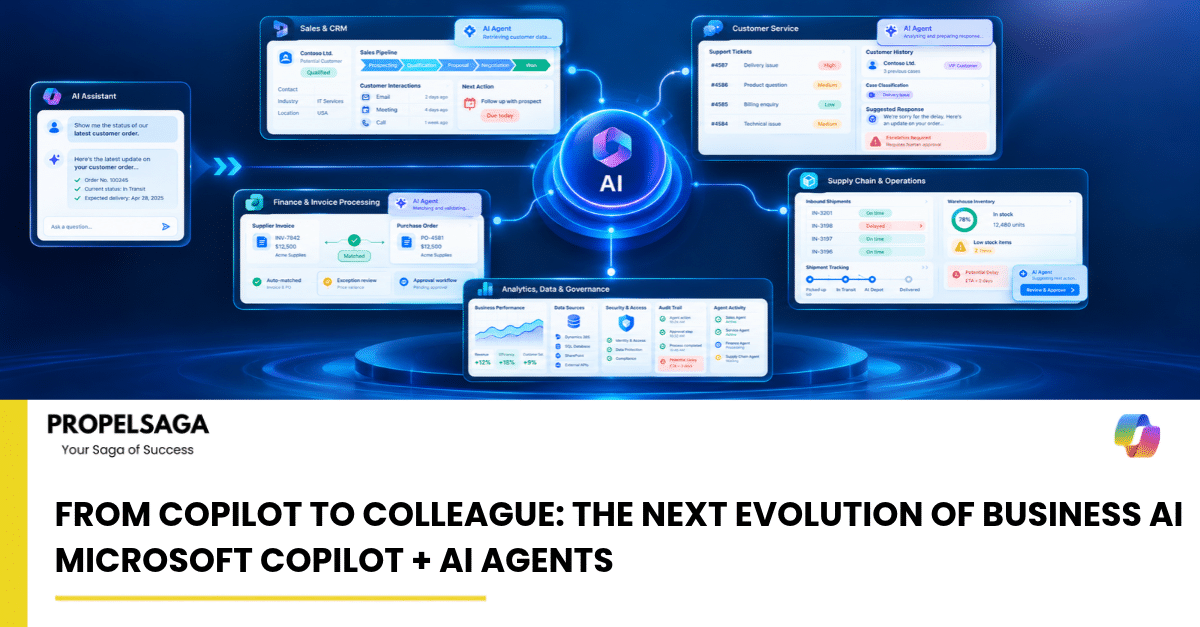
A customer enquiry arrives. An AI assistant can summarize it. An AI agent can categorize it, retrieve the customer’s order history, check the relevant business information, and either prepare a response or route the case to the right team.
That is the shift from AI assistants to AI agents, and it is where business AI is heading next.
FROM ASSISTING EMPLOYEES TO SUPPORTING BUSINESS PROCESSES
Traditional AI assistants respond to requests. An employee asks a question, writes a prompt or requests a summary, and the AI answers. Microsoft Copilot helps users do this within the applications they already use.
AI agents take this further by working towards a defined outcome. They can follow a process through multiple steps, retrieve information, use connected business systems, and take action within defined rules and permissions.
The difference is not simply that agents can do more. It is that they can connect AI to the processes through which a business operates.
THE MICROSOFT TECHNOLOGY BEHIND IT
Microsoft is bringing AI capabilities into the tools businesses already use:
- Microsoft 365 Copilot helps users find information, create content and analyze data within their everyday work.
- Copilot Studio allows businesses to build custom AI agents and connect agents to other agents, tools and business data.
- Microsoft Agent 365 helps organizations observe, govern and secure AI agents across their environment.
- Microsoft Dynamics 365 and Power Platform provide business applications, data, workflows and integration capabilities that can support AI-driven processes.
Together, these technologies give organizations ways to move from individual AI-assisted tasks towards connected business workflows.
WHAT IT LOOKS LIKE IN PRACTICE
- Sales: An agent researches a lead, drafts the first outreach message and records relevant information in the CRM. A salesperson reviews the message before it is sent.
- Customer service: An agent classifies incoming cases, retrieves relevant customer history and prepares a response. Complex cases are routed to a person.
- Finance: An agent helps match invoices with purchase orders and flags discrepancies or unusual transactions for review.
- Supply chain: An agent monitors inbound orders, identifies potential delays and prepares the relevant information for the team to decide on the next action.
These are examples of possible implementations, not automatic capabilities available in every environment. The level of automation depends on the application, data, integrations and controls the organization establishes.
TREAT AGENTS LIKE COLLEAGUES
A colleague has a defined role, limited access and someone accountable for their work. AI agents need similar boundaries: a clear scope, permissions limited to what the task requires, and appropriate monitoring and audit trails.
Not every process should run independently. Financial approvals, sensitive customer decisions and other high-impact activities may still require human review.
Businesses should decide early which tasks can be automated, which require approval, and where employees need to remain directly involved.
READINESS MATTERS MORE THAN ADOPTION
Introducing AI is easy. Making it useful across an organization is harder. If customer records are incomplete, workflows are inconsistent or responsibilities are unclear, an agent may carry those problems into automated workflows rather than solve them.
Before implementing AI agents, businesses should check:
- Process clarity: Is the workflow documented and understood?
- Data quality: Can the agent access reliable, relevant information?
- System integration: Can it work with the applications where the process takes place?
- Security and governance: Are access rights, approvals and audit requirements defined?
- Performance measurement: Can the business measure improvements in processing time, accuracy, service quality or productivity?
A successful implementation starts with a clear business problem, not with the technology.
WHERE MICROSOFT DYNAMICS 365 FITS
Microsoft Dynamics 365 connects business processes with operational data, giving organizations a foundation for exploring AI-driven workflows.
- Microsoft Dynamics 365 Business Central supports financial and operational processes for small and mid-sized businesses.
- Microsoft Dynamics 365 Finance and Supply Chain Management supports financial management, procurement, inventory and supply chain operations.
- Microsoft Dynamics 365 Customer Engagement applications support sales, customer service and customer relationship management.
Combined with Copilot, AI agents, Power Platform and the right integrations, these applications can help organizations reduce repetitive work, improve access to business information and connect activities across departments.
The objective is not to introduce AI into every process. It is to identify where AI can make a measurable difference without compromising control, security or accountability.
WHAT THIS MEANS FOR MICROSOFT PARTNERS
Customers rarely approach a Microsoft Partner asking for an AI agent. They ask for faster quotes, fewer customer escalations, cleaner pipeline data or less manual work. Partners who can connect these business needs to Copilot, Copilot Studio and Microsoft Dynamics 365 have an opportunity to lead more meaningful conversations with their customers.
The work does not end when an agent is built. Businesses may also need support with process and data readiness, system integration, governance, testing, monitoring and ongoing improvements. This creates opportunities for Microsoft Partners to build services around the complete lifecycle of AI adoption.
HOW PROPELSAGA CAN HELP
PropelSaga supports Microsoft Partners with Microsoft Dynamics 365 and Power Platform delivery under the partner’s own brand. From workflow improvements and system integration to automation and implementation support, we help partners strengthen their delivery capacity and take on additional customer engagements.
As demand for AI-enabled business solutions grows, partners can use this delivery support to explore new opportunities while keeping their core teams focused on strategic customer relationships and complex implementations.
THE FUTURE: AI THAT WORKS ALONGSIDE PEOPLE
The next phase of business AI will be measured by the business problems it helps solve, not simply by how well it answers questions. Copilot helps employees work with AI in their daily tasks. AI agents extend that capability by helping execute defined processes across connected systems, with appropriate human oversight.
The opportunity is to reduce repetitive effort, improve the flow of information and give employees more time for decisions, customer relationships and work that requires their experience. For businesses and Microsoft Partners alike, the next step is to identify the right processes, establish the right controls and turn AI capabilities into practical business outcomes.