
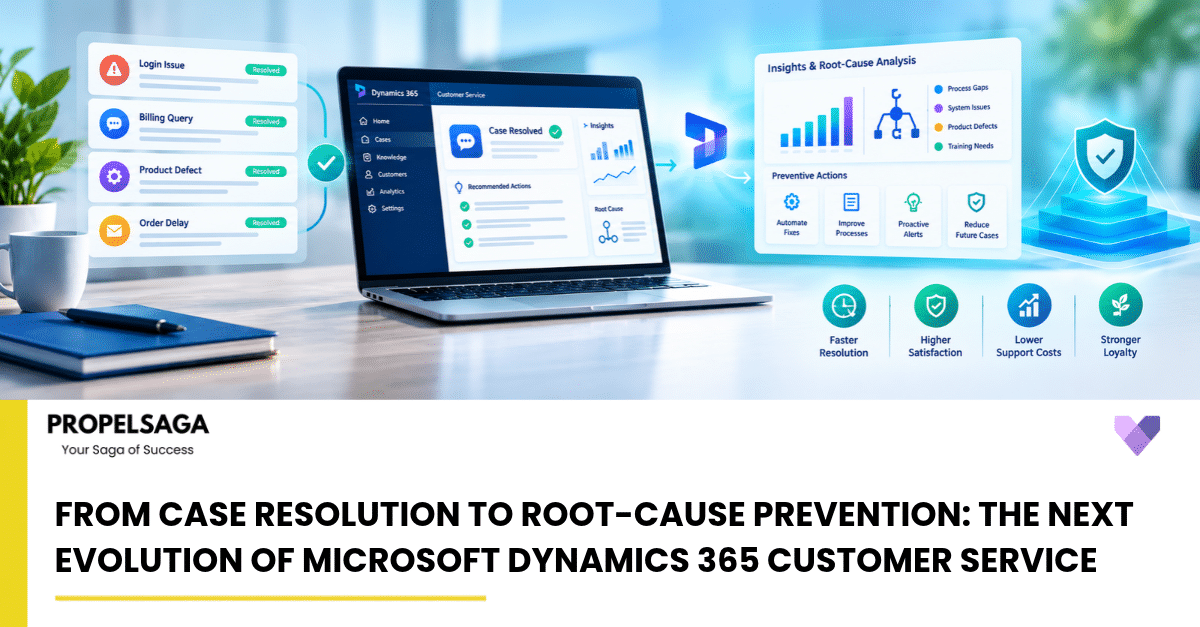
Every customer service team measures how quickly it can resolve a case. Response time, resolution time, customer satisfaction, and service-level agreement (SLA) compliance remain important indicators of performance.
But there is another question worth asking: How many of the cases being resolved today will return tomorrow?
A support team may resolve hundreds of cases every month while the same issues continue to affect customers. A recurring billing discrepancy, a delayed order, a product malfunction, or a system integration failure may be addressed individually without fixing the underlying problem.
The result is a service operation that becomes increasingly efficient at handling symptoms but never reduces their cause.
This is where Microsoft Dynamics 365 Customer Service can play a broader role—not just in managing customer cases, but in helping organizations identify recurring problems, understand their causes, and prevent avoidable issues from happening again.
The Hidden Cost of Repeated Case Resolution
Consider a business receiving dozens of customer complaints about delayed order confirmations.
The support team investigates each complaint, checks the order status, communicates with the relevant department, and closes the case once the customer receives an update.
From a case management perspective, the process works.
However, if the actual cause is a failed integration between the order management system and the customer notification platform, individual case resolution does little to address the problem.
Every new complaint consumes employee time, affects the customer experience, and creates additional operational costs.
The organization may report strong case-resolution performance while continuing to experience unnecessary service demand.
This highlights an important distinction:
- Case resolution addresses an individual customer issue.
- Root-cause analysis investigates why the issue occurred.
- Root-cause prevention uses those findings to reduce the likelihood of the issue recurring.
An effective customer service strategy needs all three.
How Microsoft Dynamics 365 Customer Service Supports This Shift
Microsoft Dynamics 365 Customer Service provides capabilities for case management, knowledge management, routing, service-level management, analytics, and AI assisted customer service workflows.
When these capabilities are connected to well designed service processes, organizations can move beyond closing cases and begin learning from the patterns within them.
1. Identify Recurring Issues Through Case Patterns
Individual cases often appear unrelated when viewed in isolation. Across hundreds or thousands of cases, however, common patterns may emerge.
Similar complaints may relate to the same product, order type, customer segment, business process, or technical failure.
Microsoft Dynamics 365 Customer Service helps organizations capture and organize case information, making it easier to categorize issues and analyze service trends. Reporting and dashboards can help teams identify categories with unusually high volumes, repeated escalations, or growing resolution times.
For example, a sudden increase in cases concerning invoice discrepancies may indicate a broader issue with pricing rules, customer data, or invoice processing.
Instead of treating every complaint as a separate incident, service leaders can investigate whether multiple cases share a common cause.
The quality of this analysis depends on consistent case categorization, useful data, and appropriate reporting.
2. Use AI to Reveal Patterns and Support Investigation
AI can help service teams understand what is happening across customer interactions without requiring employees to manually review every case.
Depending on the configured capabilities and available data, Microsoft Dynamics 365 Customer Service can support AI assisted case summarization, suggested responses, knowledge recommendations, and service analytics.
These capabilities can reduce the effort involved in reviewing case histories and identifying relevant information.
For example, when several customers report that a particular transaction is failing, AI assisted analysis may help employees summarize the reported symptoms, compare case details, and identify common themes for further investigation.
However, identifying a pattern is not the same as confirming its cause. Teams must validate findings against application logs, transaction records, business rules, integrations, and other relevant evidence.
The real value of AI is not simply producing faster answers. It is helping employees investigate problems more effectively and make better-informed decisions.
3. Connect Customer Service Insights with Business Operations
Many recurring customer service issues originate outside the customer service department.
A delivery complaint may originate in supply chain operations. A billing dispute may be caused by an incorrect financial transaction. A product availability enquiry may reflect inventory inaccuracies. A customer account issue may originate in CRM data or an integration.
Resolving these issues permanently often requires information and action across multiple systems.
Microsoft Dynamics 365 Customer Service can work alongside other business applications, including Microsoft Dynamics 365 Finance, Supply Chain Management, Sales, and the Power Platform, to support connected service workflows.
For example, if customer complaints repeatedly concern incorrect order status, an organization may investigate data synchronization between its operational systems and customer facing channels. Once the underlying issue is confirmed, the responsible team can correct the integration or process and establish monitoring to detect future failures.
This is where integration and process automation become important. Customer service identifies the recurring problem, operational teams investigate it, and the appropriate technology or process change addresses its cause.
4. Turn Repeated Cases into Structured Knowledge
When the same question or issue appears repeatedly, the organization may be missing an opportunity to convert experience into reusable knowledge.
Microsoft Dynamics 365 Customer Service supports knowledge management so that teams can create, maintain, and recommend relevant articles to employees and, where appropriate, customers.
For recurring issues, knowledge articles can document:
- Common symptoms and diagnostic steps.
- Verified causes and resolution procedures.
- Preventive checks and recommended actions.
- Escalation criteria and responsible teams.
This helps employees resolve known issues consistently and reduces dependence on individual experience.
Over time, validated knowledge can also reveal process weaknesses. If employees repeatedly need to explain the same confusing policy or workaround, the organization may need to improve the underlying product, communication, or business process—not simply publish another article.
5. Automate Preventive Actions, Not Just Service Responses
Once an organization understands why an issue occurs, it can explore whether the response can be automated or prevented altogether.
Power Automate and other supported workflow capabilities can help implement appropriate actions across connected applications.
Consider a scenario in which customer cases repeatedly arise because required information is missing from an order.
After validating the cause, the organization could introduce a workflow that checks for required information earlier in the process, alerts the responsible team, or prevents an incomplete transaction from progressing where business rules permit.
Similarly, recurring service issues may trigger notifications, create an internal investigation task, or escalate a suspected widespread incident.
The objective is to intervene at the earliest practical point before the same failure generates another customer complaint.
Automation should follow a verified business rule, with appropriate permissions, exception handling, and human oversight for decisions that require judgment.
Measure Prevention Alongside Resolution
Traditional customer service metrics remain essential, but they do not tell the entire story.
An organization focused on continuous improvement should also measure whether the volume of avoidable service demand is decreasing.
Useful indicators include:
| Metric | What it reveals |
| First contact resolution | How often issues are resolved during the initial interaction |
| Average resolution time | How efficiently cases are resolved |
| Repeat contact rate | How frequently customers return about the same issue |
| Recurring case volume | Whether particular problems continue to generate demand |
| Reopened case rate | Whether reported resolutions are holding up |
| Time to identify root cause | How quickly the organization understands the underlying problem |
| Preventive action completion | Whether agreed corrective actions are implemented |
| Post-fix recurrence rate | Whether the issue returns after corrective action |
These measures should be interpreted together. For example, a reduction in case volume is not necessarily an improvement if customers have difficulty reaching support or issues are being misclassified.
The strongest signal of progress is a sustained reduction in verified recurring problems with
How PropelSaga Can Help: From Case Resolution to Root Cause Prevention
Moving from reactive customer support to proactive service management requires more than a case management system. It requires the right configuration, connected business processes, reliable data, and automation that addresses recurring issues at their source.
PropelSaga helps Microsoft Dynamics 365 partners strengthen their Customer Service delivery capabilities through technical expertise, integration, customization, and implementation support.
Our team can help with:
- Microsoft Dynamics 365 Customer Service Implementation and Enhancement: Configure case management, queues, routing, service-level agreements, and escalation workflows to improve how service teams handle customer issues.
- AI-Enabled Service Operations: Implement and enhance supported AI capabilities to assist with case summarization, knowledge recommendations, and service workflows, helping teams identify patterns and investigate recurring issues more effectively.
- Integration With ERP and Business Applications: Connect customer service processes with Dynamics 365 Business Central, Finance, Supply Chain Management, and other business applications where appropriate, helping teams investigate issues that originate beyond the service desk.
- Power Platform and Workflow Automation: Use Power Automate and related Power Platform capabilities to automate alerts, escalation processes, corrective-action tracking, and preventive checks based on validated business rules.
- Reporting and Service Insights: Develop reporting and analytics that help organizations monitor recurring case categories, repeat contacts, resolution trends, and the effectiveness of corrective actions.
For Microsoft Dynamics 365 partners, PropelSaga provides access to specialized Biz Apps expertise to support project delivery, extend technical capabilities, and execute customer service improvement initiatives.
The objective is simple: help organizations move beyond repeatedly resolving customer complaints toward identifying their underlying causes, improving business processes, and reducing avoidable service demand.
With PropelSaga, Dynamics 365 Customer Service becomes an opportunity not only to resolve customer issues, but also to continuously improve the business processes behind them.
Explore how PropelSaga can support your Microsoft Dynamics 365 initiatives at propelsaga.com or contact us at connect@propelsaga.com.
#MicrosoftDynamics365 #Dynamics365CustomerService #PowerPlatform #CustomerExperience #PropelSaga